Saturday, January 8, 2022

Winter Wildlife!

Columbian Black-tailed Mule Deer - Odocoileus hemionus columbianus

With the power being out for the last 12 days, I have had a lot of time to wander and observe wildlife in my neighborhood lately!  I've seen more deer than I have all year, as they are so visible against the white snow! Females and males travel separately in small groups of their own gender. In the winter they forage mainly on the growing tips of trees and shrubs, as well as acorns and grasses. In the fall, they consume lots of vegetation and store up fat for the winter, when food can be scarce.

Columbian Black-tailed Mule Deer - Odocoileus hemionus columbianus

I came across this doe and fawn one morning, as they were grazing on the buds and shoots of trees.  Such beauty!  Mule Deer grow thick, shaggy, hollow-haired, grayish-brown coats in the winter, which helps them retain warmth.

Columbian Black-tailed Mule Deer - Odocoileus hemionus columbianus

I also came across a group of four bucks in another part of our neighborhood!  They all had different sizes of antlers, which they will shed sometime between January and March. While I was watching them, one of them repeatedly rubbed his antlers against the tree branches.  In winter deer conserve energy by limiting their movement.  They are most active at dawn and dusk, but can be seen at any time.  They usually live 9-11 years in the wild.

Columbian Black-tailed Mule Deer - Odocoileus hemionus columbianus

In the photos above you can see the difference in the antler size of the deer.  Antler size is not a reliable indicator of their age. There is really no precise way to accurately do deer aging, other than looking at their teeth. "Despite the many stories hunters tell each other, the size of the antlers and the number of points on the antlers is not a reliable age guide. Antler size is more a function of diet and heredity than it is of age. Three major factors that determine antler size are: age of the buck, genetics of the animal, and nutrition. Said another way, you will not get maximum antler size unless the animal has the genetics, is a healthy mature buck more than 5years old, and has consumed the nutrients needed to achieve the genetic potential."

Western Gray Squirrel - Sciurus griseus

There are probably about 6 or 7 Western Gray Squirrels in my immediate neighborhood.  They remain active all year.  They are called "scatter hoarders" because they store small caches of food in many different places, rather than one main location. These caches are not what the squirrels solely subsist on in winter. They also actively search for food in winter, foraging for pine nuts, acorns, tree buds, and mushrooms.

Their nests are called "dreys" and are made of twigs, leaves, sticks, moss, lichen and shredded bark. They prefer to make their nest in the top third of a tree, but will also nest in hollow tree branches or trunks. During the winter, and in the nesting season, their dreys are covered on top. In the summer they may also construct and open-air sleeping platform!

Western Gray Squirrel - Sciurus griseus

I took this photo before all the snow came!  These two Gray Squirrels were up in the leafless branches of some Big-leaf Maples, busily eating the seeds! I thought it was an unusual sight to see!

Chickaree/Douglas Squirrel - Tamiasciurus douglasii

There are 2 Chickarees that live right near our home! They too have been busy storing seeds and nuts! Unlike the Western Gray Squirrel, they will store lots of green cones for the winter in only one or two main areas. During winter they will dig down through the snow to these caches, or "middens", and feast on the seeds in the cones! They will also forage for food such as nuts, acorns, berries, tree buds, fungi, and insects!

In winter they mainly nest in hollow trees or abandoned woodpecker cavities. They may also build a ball or cup-shaped nest 15'-20' up a tree, from twigs, moss, lichen and shredded bark. In colder northern areas they may even dig a burrow underground, right under one of their food caches!

In summer their fur is reddish brown in color, in winter it is grayish brown. 

Gray Fox - Urocyon cinereoargenteus

I haven't seen any foxes lately, but their tracks in the snow are all over my neighborhood!  I took the photo above a few years ago.  Surviving in the winter can be tough for foxes. There isn't as much food available, so they have to spend a lot more time hunting. Although mostly nocturnal, they will also hunt during daylight if necessary. To stay warm, they develop a thick coat of fur in winter. They also like to sunbathe on sunny days! Curiously, they seldom sleep in a den during winter. They usually just curl up in a protected area, such as under dense, thick, brambles, or in a rocky crevice or rotten log! A grey fox’s home range usually extends from about two to seven miles, but they only cover a small portion of this every day. Since this home range is not large they know it very well, including the behaviors of their potential prey as well as their predators!  They will also eat seeds, acorns, nuts, berries, tree buds, fungi.

Sharp-shinned Hawk (juvenile) - Accipiter striatus

I spotted this beautiful little Sharp-shinned Hawk one snowy morning this week!  It was perched in the Alder tree near our garden, where I have photographed it several times in the past.  The Sharp-shinned Hawk is the smallest hawk in the US and Canada. They are forest predators, like the Northern Goshawk. The Cornell Lab of Ornithology states, "These raptors have distinctive proportions: long legs, short wings, and very long tails, which they use for navigating their deep-woods homes at top speed in pursuit of songbirds and mice." Small songbirds are the main prey of this hawk species, and there are lots of songbirds in our garden right now! They use surprise attack as their main method of capture. They will eat birds as small as an Anna's Hummingbird, or as large as a Mountain Quail! They will pluck off most of the feathers of their prey before they eat them!

Sharp-shinned Hawk (juvenile) - Accipiter striatus

While I was photographing this little hawk, it suddenly took off, flew over my head and was instantly in hot pursuit of a Steller's Jay!  I saw them as they sped down the road in the air.  I don't know if the hawk got the jay, but it was fascinating to see! 

American Kestrel (male) - Falco sparverius

Just this week I was thrilled to see a male American Kestrel perched in the top of one of the pines on the open slope! WOW!!! I'd seen one there just about a year ago, on January 15, 2021.  Last year it stuck around for about a week.  I'll bet this is the same Kestrel!  He is so beautiful!  American Kestrels are the smallest falcon in North America, measuring 9" in length, with a wingspan of 22", and a weight of 4.1oz. Their diet consists primarily of insects and small rodents such as: grasshoppers, beetles, dragonflies, scorpions, spiders, butterflies, moths, voles, mice, shrews, bats, snakes, lizards, frogs, and small songbirds! Right now there aren't many insects around, so it was probably hunting for rodents in the field.

Red-shouldered Hawk - Mountain Quail remains 
Buteo lineatus - Oreortyx pictus

A day after I'd seen the Sharp-shinned Hawk near our garden, I spotted this Red-shouldered Hawk on the ground under a table where I used to feed the local wild birds.  I thought that maybe it was soaked, starved and freezing because of the snowy weather, but I left it alone and went on my walk.  When I came back an hour later, it was still there!  So I thought I could "help" it and give it some food.  I went home and defrosted some raw chicken and brought it down to the hawk. Just as I was putting the chicken on the ground a short distance from the hawk, it took off with a dead quail in its talons!  The quail was too heavy for the hawk to carry, so it dropped it in the deep snow and flew off. Geeze!  I messed everything up!  Luckily I found the dead quail and put it on top of the table, hoping the hawk would return and eat it.  Several hours later, I went on another walk and the quail carcass had been cleaned out by the hawk!  Only a few bones, the feet, and the intestines were left!  WOW!!!  I was so relieved that the hawk came back and ate the quail!  I felt so bad that I had chased it off!  Once again I've learned that I should always leave wild things wild! 

Mountain Quail - Oreortyx pictus

I've been seeing several coveys of 6-9 Mountain Quail in our neighborhood this week.  These beautiful birds are way more visible on the white snow than they are in the summer! They are the largest North American quail, measuring 11" in height, with a wingspan of 16", and a weight of 8 oz. Every spring they walk as much as 20 miles up to their breeding/nesting grounds at higher elevations. In the fall they walk back to down to lower elevations to spend the winter. They eat a large variety of plants and seeds.  In the fall and winter they stay together in small coveys of family related groups, while foraging and roosting.

Mountain Quail (male) - Oreortyx pictus

They are different from other Quail in that they are sexually monomorphic (the male and female look alike).  I love their bobbing head feathers!

Common Raven - Corvus corax

We have  a pair of Common Ravens that have lived in our neighborhood for years and years.  I delight in how they are constantly calling to each other as they search and perch in our neighborhood.  Their typical food source is carrion from roadkill, but they are omnivores and will eat almost anything, including garbage and pet food!  It isn't known whether Ravens mate for life, but these two certainly seem to be dedicated to each other!  I love seeing them every day!

Pine Siskins - Pinus spinus

To my delight I have had many sightings of Pine Siskin flocks in our neighborhood this winter.  Last year their population declined dramatically due to an outbreak of Salmonella contracted from bird feeders. My blog on February 6, 2021 is all about this outbreak. So please, if you choose to feed birds in the winter PLEASE keep your feeders clean!  Detailed information on possible diseases caused by unsanitary bird feeders, and how to keep your bird feeders clean is in my December 15, 2019 blog. 

Pine Siskins - Pinus spinus

Pine Siskins are named for their preference for pine and other conifer seeds. They will hang from the tips of branches to glean seeds from the cones. They also feed on the ground for a wide variety of grass and shrub seeds, garden vegetable leaves and stems, and insects. Sap in tree trunk holes, that Sapsuckers have made, can also be part of their diet! They will also ingest minerals along the sides of roads! They range widely and erratically in response to seed crops. Their main food in winter is cone seeds and tree buds. Locally they've been eating the seeds from this year's alder cones.

Pine Siskins - Pinus spinus

Recently the snow plows have uncovered some bare dirt which is apparently rich with seeds.  I loved watching this small flock of Pine Siskins feast on this wealth of food!

When food is plentiful they will store lots of seeds in their crop, which gets them through cold winter nights. Unlike hummingbirds, that go into a state of torpor overnight, Pine Siskins ramp up their metabolic rate to stay warm at night! They also put on a layer of fat for winter! I love watching these little birds and hearing their busy chatter as they forage and perch in the trees! They travel in small to large flocks all year.

Clearing Skies after the Big Storm

Damp Earth Art

This week the weather calmed down, thank goodness! We had several warmer, sunny days, and only about .55" of rain and no snow. The roads were cleared and re-opened and our power was restored after 12 days!  Yahoo!  In the meantime, I'm continuing my constant hope for rain (or snow!). Please join me! Perhaps our collective efforts may help it happen. I'm going to keep posting rain inspired writings, art, etc. on my blog at dampearthart.blogspot.com. Any submissions would be greatly appreciated. 


What's happening at the local ponds?

What else is inhabiting the damp rocky slopes in our neighborhood,
besides the ferns, lichen, and moss?

Check back next week for the answers to these questions and more.

Unfortunately, you can no longer sign up to get my blog via email. Just go to northyubanaturalist.blogspot.com directly. It looks better than the emailed version!

Your questions and comments are greatly appreciated. Please feel free to email me at northyubanaturalist@gmail.com. Thanks!

Sunday, January 2, 2022

LOTS of Snow!

Saddleback - 12/29/21

Over the past week we received 10.65" of precipitation, and ended up with three feet of snow on the ground! Up in Sierra City they got five to six feet of snow! The Lakes Basin must be buried! The power went out, the roads closed, and the temperatures dropped.  It was quite a mess!  We haven't seen a snowfall like this in years and years!

Unfortunately our power is STILL out and it doesn't look like it will be back on anytime soon.  Since we are using a small generator to provide power to our house, my computer time has become quite limited.  So, I can't post a new blog this week.  However, I have been out walking several times a day, and have seen a lot of wildlife!  Check back next week to see what I observed!  Hopefully the power will be back on by then!  Fingers crossed!

My neighborhood - January 2017

Damp Earth Art

With the 10.65" of precipitation that we received this week, our water year total (since Oct. 1, 2021) is approximately 40"! Yahoo!  So we are more than half way to achieving our average rainfall total of 60+"! WOW!!! More rain and snow is predicted for the coming week! My fingers are crossed that we get lots of precipitation! In the meantime, I'm continuing my constant hope for rain (or snow!). Please join me! Perhaps our collective efforts may help it happen. I'm going to keep posting rain inspired writings, art, etc. on my blog at dampearthart.blogspot.com. Any submissions would be greatly appreciated. In the meantime pray/wish/hope/dance for rain!

What mammals are around?

What birds are around?

What else is inhabiting the damp rocky slopes in our neighborhood,
besides the ferns, lichen, and moss?

Check back next week for the answers to these questions and more.

Unfortunately, you can no longer sign up to get my blog via email. Just go to northyubanaturalist.blogspot.com directly. It looks better than the emailed version!

Your questions and comments are greatly appreciated. Please feel free to email me at northyubanaturalist@gmail.com. Thanks!

Thursday, December 23, 2021

Another Year!

Skeleton Weed seeds suspended in spider web threads

Five years ago, on December 23, 2016, I published the first post of my North Yuba Naturalist blog!  272 posts later, I still love sharing my natural history observations and photographs with "the world"!  This year, 7,494 people from 92 different countries visited my blog!  Wow!  A big "thank you" goes to those of you who have sent me your heartfelt comments!  I really appreciate your enthusiasm for my blog!

The smoke and threat of local wildfires curbed my ability to get out in nature this past year, and was also quite stressful. I feel my blogs during last summer and early fall weren't so great. Some were quite brief, some photos were used more than once, and a lot of material from previous blogs was re-used. I apologize for the lapse in focus!  

Despite the smoke, I still managed to see lots of incredible landscapes, birds, wildflowers, and mammals!  I hope you enjoy the photo-composites below of some of the amazing beauty that enchanted me this year!


Pyrocumulus cloud from the Dixie Fire 
Smoky North Yuba River Canyon - Smoky Sierra Buttes
Misty Sierra Buttes from Wild Plum Trail - Spring Blizzard off the Gold Lake Road
Springtime on the Salmon Creek headwaters - Wet meadow near Goose Lake
Helgrammite Lake - North Yuba River
Cottonwoods off of Hwy 49 - Indian Rhubarb on the North Yuba River
Fall pond off the Grassy Lake Trail

I am so grateful for my fabulous camera, a Nikon Coolpix P900.  It has made it possible for me to photograph beauty near and far, time and time again!


Snowy Egrets
Northern Pygmy-Owl - Great Horned Owl
Male Yellow-headed Blackbird - Male American Kestrel
Juvenile Northern Goshawk - Juvenile Sooty Grouse
Sage Thrasher - Male Yellow-breasted Chat
Female Williamson's Sapsucker - Male White-headed Woodpecker
American White Pelicans

I am so grateful for the Cornell Lab of Ornithology 
and their amazing website, birdsoftheworld.org.  The information is incredible as well as the photographs, and recordings of bird songs.


Meadow Penstemon
Showy Penstemon - Showy Phlox
Bitterroot - Naked Broomrape
Confusing Petrophila Moth - Sand/Star Lily
Porterella - Pink Woodland Star
True Baby Stars - Harvest Brodiaea
Mountain Pride

I am also so grateful for the www.calflora.org website. It is an incredible resource for identifying flowers/plants, with 1,000's of photos. The www.bugguide.net website has been my source for identifying the local insects. It too provides 1,000's of photos and an identification service!


American Black Bear female with cubs
Gray Fox - Columbian Black-tailed Deer, doe & fawn
Yellow-bellied Marmot - Lodgepole Chipmunk
Golden-mantled Ground Squirrel - Western Gray Squirrel
River Otter - Columbian Black-tailed Deer, buck
Chickaree/Douglas Tree Squirrel - American Black Bear
Pronghorns

I am so grateful for all the information available about our local mammals on the internet, most notably www.animaldiversity.org. It provides excellent information on the habits of our local wildlife.

Best wishes to all of you for 
the coming New Year!

Check back next week for the latest edition of
northyubanaturalist.blogspot.com!

Unfortunately, you can no longer sign up to get my blog via email. Just go to northyubanaturalist.blogspot.com directly. It looks better than the emailed version!

Your comments and questions are greatly appreciated!
Please email me at northyubanaturalist@gmail.com

Monday, December 20, 2021

Saturday, December 18, 2021

Winter has arrived!

Saddleback - 12/9/21

Winter arrived in a five day storm this week!  We received 10.11" of precipitation, most of it in the form of rain!!! Yahoo! Higher elevations got several feet of snow.  We ended up with about 4" of snow on the ground in our neighborhood! Since then we've had a few sunny but COLD days, with daytime temperatures in the 40's! What a difference from two weeks ago, when the temperatures were in the  70's!  More rain and snow is predicted for the coming week!  I hope the storms keep coming and wash this drought away!
 

Light snow on the Ridgetop

North Yuba River 

Before the Storm!

Before the recent storm, the river was quite low and there was still a little fall color along its shoreline. Right now the river is UP, with a gain of 3' in height and an increased flow rate from 445 cfs to 761 cfs (cubic feet per second).  Almost every single fall-colored leaf has dropped, and now the dominate colors are the beautiful clear jade-green of the river, the ochres and rusts of the bare willows, and tawny husks of the dried grasses. Just beautiful!

Winter River

Bald Eagle above the North Yuba River - Haliaeetus leucocephalus

About a week before the storm, I spotted a Bald Eagle perched above the river!  Although I usually see one during the summer and fall, this is the first one I've seen in the past 6 months! It was scanning the river for prey. Fish, waterfowl, and mammals are their main diet.  I've been looking for fish in the river myself!  The clearness of the water should make fish more visible, but I haven't seen any lately. Right now the river is a chilly 42 degrees! Being coldblooded, trout become less active when the the water temperature drops below 40 degrees. Their metabolism and respiratory rates slow down. Adult trout usually stay in deep pools during fall and winter. To keep from being eaten, young trout stay away from adult trout, and spend the winter in shallower pools near the shore, where overhanging branches provide cover.

Common Goldeneye (females - male) - Bucephala clangula

Also about a week before the storm, Common Goldeneye ducks arrived on the river! Perhaps they are the ones we saw on Salmon Lake about 3 weeks ago! These ducks will spend the winter here. In California, Common Goldeneyes are the only ducks that regularly spend the winter on rivers and lakes above the foothills of the western Sierra. They are diving ducks and eat fish, aquatic vertebrates, seeds, and tubers. When diving, they keep their wings pressed to their sides underwater, and swim with their webbed feet! They are amazing to watch when they're underwater! Right now the males are in their black and white mating colors.  The females have a yellow tip to their bill during mating season.  Right now pair formation is just starting! They will migrate to their northern breeding grounds in Alaska and Canada in the spring.  I am so thrilled that they have returned to our neighborhood for the winter!
 
Common Merganser (male -female) - Mergus merganser

The most common waterfowl we see on the river in the spring, summer, and fall are the Common Mergansers.  They breed and raise their young up here, and migrate down to lower elevations in the winter. Like the Common Goldeneyes they are diving ducks, and eat fish, aquatic mollusks, insects, crustaceans, worms, frogs, small mammals, and plants. Pair formation has just begun, and the males are in their breeding colors! Right now there are still a few of them on the North Yuba River.

River Otter tracks (front feet - front and hind feet) - Lontra canadensis

A few weeks ago, my friend BJ and I hiked down to a section of the river that usually has two lovely beaches.  This year one beach has been divided into two sections by the high water, and the other beach is overgrown with willows!  In the damp sand we came across multiple tracks of River Otters, but we didn't see any of them. 

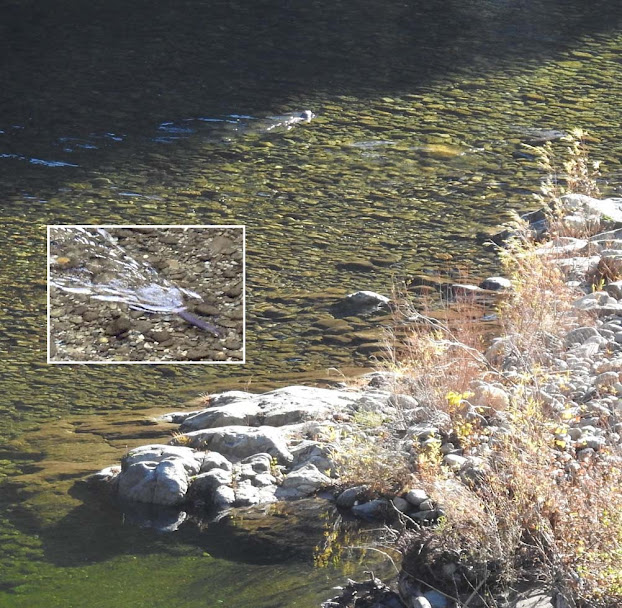
River Otter - Lontra canadensis 
inset: unidentified swimming mammal

About a week later, I was walking along the open slope when I spotted two River Otters in the river below! They were so far away that it was difficult to photograph them. You can see the head of one lit up in the sun in the photo above. During the following week I spotted a smaller underwater mammal on the same section of the river!  Again, because it was so far away it was hard to photograph (see inset above). The photos are too vague to identify the mammal, but my guess is that it was an American Mink!  Hopefully I'll see these aquatic mammals again this winter!


Damp Earth Art

With the 10.11" of precipitation that we received this week, our water year total (since Oct. 1, 2021) is approximately 30"! Yahoo!  Last year at this time we had only received approximately 8" of precipitation, and our total FOR THE ENTIRE WATER YEAR in 2021 was only 29.58" of precipitation!!!  So we are about half way to achieving our average rainfall of 60+"! WOW!!! More rain and snow is predicted for the coming week! My fingers are crossed that we get lots of precipitation! In the meantime, I'm continuing my constant hope for rain (or snow!). Please join me! Perhaps our collective efforts may help it happen. I'm going to keep posting rain inspired writings, art, etc. on my blog at dampearthart.blogspot.com. Any submissions would be greatly appreciated. In the meantime pray/wish/hope/dance for rain!


What mammals are around?

What else is inhabiting the damp rocky slopes in our neighborhood, 
besides the ferns, lichen, and moss?

Check back next week for the answers to these questions and more.

Unfortunately, you can no longer sign up to get my blog via email. Just go to northyubanaturalist.blogspot.com directly. It looks better than the emailed version!

Your questions and comments are greatly appreciated. Please feel free to email me at northyubanaturalist@gmail.com. Thanks!

Saturday, December 11, 2021

Local Ferns

Western Polypody & Dendroalsia Moss
Polypodium hesperium - Dendroalsia albietina

With no wildflowers to distract me, I've been focusing on our local ferns, which have been flourishing in the recent rains. Last winter I mentioned that ferns have a diploid/haploid alternation of generations, but I didn't really explain how that works. This year I decided to do some more research on that topic. Luckily I found the following website, https://www.thoughtco.com/fern-life-cycle-4158558, which is an amazing source of information about ferns.  The following quote from this website explains the fern life-cycle well, and thoroughly.  I have edited it a little to simplify the information.

Giant Chain Fern sori that contain spores - Woodwardia fimbriata

"The fern life cycle requires two generations of plants to complete itself. This is called "alternation of generations".

One generation is diploid, meaning it carries two identical sets of chromosomes in each cell or the full genetic complement (like a human cell). The leafy fern with spores is part of the diploid generation, called the sporophyte.

A fern's spores don't grow into leafy sporophyte. They aren't like seeds of flowering plants. Instead, they produce a haploid generation. In a haploid plant, each cell contains one set of chromosomes or half the genetic complement (like a human sperm or egg cell). This version of the plant looks like a little heart-shaped plantlet. It is called the prothallus or gametophyte.

The Fern Life Cycle
 
Starting with the "fern" as we recognize it (the sporophyte), 
the life cycle follows these steps:

1)The diploid sporophyte produces haploid spores.

2)Each spore grows into a photosynthetic prothallus (gametophyte). 
This plantlet is much smaller than the sporophyte fern.

3)Each prothallus produces gametes. Sperm is produced within a structure called an antheridium. The egg is produced within a similar structure called an archegonium. When water is present, sperm use their flagella to swim to an egg and ​fertilize it.

4)The fertilized egg remains attached to the prothallus. The egg is a diploid zygote formed by the combination of DNA from the egg and sperm. The zygote grows into the diploid sporophyte, completing the life cycle.

Before scientists understood genetics, fern reproduction was mystifying. It appeared as though adult ferns arose from spores. In a sense, this is true, but the tiny plantlets that emerge from spores are genetically different from adult ferns.

Fern life cycle - mariaflaya/Getty Images

Other Ways Ferns Reproduce

The fern "life cycle" refers to sexual reproduction. However, ferns use asexual methods to reproduce, too.

In apogamy, a sporophyte grows into a gametophyte without fertilization occurring. Ferns use this method of reproduction when conditions are too dry to permit fertilization.

Ferns can produce baby ferns at proliferous frond tips. As the baby fern grows, its weight causes the frond to droop toward the ground. Once the baby fern roots itself, it can survive separate from the parent plant. The proliferous baby plant is genetically identical to its parent. Ferns use this as a method of quick reproduction.

The rhizomes (fibrous structures that resemble roots) can spread through soil, sprouting new ferns. Ferns grown from rhizomes are also identical to their parents. This is another method that permits quick reproduction."

Liverworts - division Marchantiophyta

Armed with the knowledge of the fern life-cycle, I went in search of the haploid gametophytes this week. There's a mossy wet bank in our neighborhood that has lots of ferns growing on it.  I examined the bank carefully, and in some damp, recessed, rock shelves I thought I found some gametophytes. They were tiny, about half the size of my little fingernail. I've since asked my friend who is a botanist to identify them, and she said that they were liverworts, not fern gametophytes. So I'll keep looking and maybe I'll get lucky!

Lace Fern & Dendroalsia Moss  
Myriopteris gracillima - Dendroalsia albietina

I've also decided to learn the names of all the local ferns.  Here's a photo gallery of some of the ones I've learned.  The Lace Fern pictured above is easily distinguished by its finely divided fronds with lots of small pinnae (leaflets), and orange hairs on the underside of the fronds.

Giant Chain Fern - Woodwardia fimbriata

The Giant Chain Fern is easily distinguished by its three-foot-long fern fronds!

Western Polypody - Polypodium hesperium

I think lots of these Western Polypody Ferns just sprouted this past fall, when the rains came. I'll have to watch them through the year and see if they die off in the heat of the summer.  I need to be more observant!

Five-finger Fern - Adiantum aleuticum

These delicate Five-finger Ferns die back in the Winter and re-grow in the Spring.

Snow Geese - Anser caerulescens

Gray Lodge Wildlife Area

The day after Thanksgiving, my husband and I made our annual drive down to the Gray Lodge Wildlife Area in California's Central Valley.  It's always a joy to visit this refuge!  We walked for hours through the reserve, enjoying the countless waterfowl, shorebirds, songbirds, and raptors that inhabit Gray Lodge in the winter!  As in years past, there were thousands of Snow Geese arriving from the arctic, circling around and landing in the refuge, one of the most beautiful sights I've ever seen!  

I've written about Gray Lodge in many previous blogs. Just enter "Gray Lodge" in the "search this blog" bar on the top right for more information and photos.

Northern Mockingbird - California Scrub Jay - Golden-crowned Sparrow
Mimus polyglottos - Aphelocoma californica - Zonotrichia atricapilla

In addition to the wetlands, the refuge has many shrubs and Cottonwood trees that birds perch in and inhabit.  

Snow Geese - Anser caerulescens

At certain angles the Snow Geese almost disappear from view!

Black-necked Stilt - Northern Shoveler - Greater White-fronted Goose
Himantopus mexicanus - Anas clypeata - Anser albifrons

The shorebirds and waterfowl, besides the Snow Geese, are also numerous and beautiful to watch!

Snow Geese - Anser caerulescens

I never tire of watching and hearing the hundreds of Snow Geese arrive at the refuge!

Raindrops on bare Maple branches

Damp Earth Art

We received .69" of rain over the past week! Yay! Heavy rain and snow is predicted for the coming week!  My fingers are crossed that we get lots of precipitation! In the meantime, I'm continuing my constant hope for rain (or snow!). Please join me! Perhaps our collective efforts may help it happen. I'm going to keep posting rain inspired writings, art, etc. on my blog at dampearthart.blogspot.com. Any submissions would be greatly appreciated. In the meantime pray/wish/hope/dance for rain!

Is there any Fall color left?

What's happening on the river?

What mammals are around?

Check back next week for the answers to these questions and more.

Unfortunately, you can no longer sign up to get my blog via email. Just go to northyubanaturalist.blogspot.com directly. It looks better than the emailed version!

Your questions and comments are greatly appreciated. Please feel free to email me at northyubanaturalist@gmail.com. Thanks!