Saturday, September 2, 2023

Mammals of the Lakes Basin

Lodgepole Chipmunk (?) - Tamias speciosus

There are over 40 mammals that inhabit the Lakes Basin including;  Black Bear, Mule Deer, Mountain Lion, Bobcat, Coyote, Gray Fox, Pine Marten, River Otter, Weasel, Skunk, Raccoon, Marmot, Beaver, Mountain Beaver, Porcupine, Jackrabbit, Snowshoe Hare, Cottontail Rabbit, Pika, Flying Squirrel, Douglas Squirrel, Belding's Ground Squirrel, Golden-mantled Ground Squirrel, Chipmunk (5 kinds), Mole, Gopher, Rat (2 kinds), Mice (3 kinds), Vole (2 kinds), Shrew (2 kinds), and Bat (5 kinds)! 

I haven't even seen half of these mammals, for several reasons. Firstly, a lot of them are active at night or live underground. Secondly, they are usually very good at being quiet and undetected. Whenever I see a wild animal it is already looking at me and withdrawing from view. Thirdly, they aren't that numerous!  Below, is a short account of the mammals I have been lucky enough to photograph in the Lakes Basin!

The cute little Chipmunk above was eating some kind of seed right off the trail. It didn't seem disturbed by us at all, and stayed there until it was done eating! There are at least 5 different kinds of Chipmunks inhabiting the coniferous forests of the Lakes Basin. In the field they are very difficult to identify, as they are so close in coloration. I think the one pictured above might be a Lodgepole Chipmunk, and the one pictured below might be a Long-eared Chipmunk. They are both common in the Lakes Basin.

Long-eared Chipmunk (?) - Tamias quadrimaculatus

Chipmunks are primarily fruit, nut, and seed eaters, but will also eat fungi (primarily truffles), bird eggs, and insects (caterpillars, aphids, termites, ants etc.). They are known for climbing trees and shrubs to find food. They all have fur-lined internal cheek pouches for carrying nuts and seeds. They cache food for winter as they do not hibernate. They sleep most of the winter and awaken periodically to eat. Their nests maybe be in an underground burrow, or in cavities of trees, logs, stumps, or snags. 

Golden-mantled Ground Squirrel - Spermophilus lateralis

 Golden-mantled Ground Squirrels are not as commonly seen as Chipmunks, neither are they related. Visually they are easily distinguished from Chipmunks, by the lack of stripes on their head. They also don't climb trees and shrubs to get seeds, but prefer to eat them on the ground. In addition to seeds, nuts, fruits, and fungi, they also eat grasses and leaves. Although not as much of an insect eater as a Chipmunk, they will eat them if they are easily available.  These squirrels hibernate in an underground burrow in the winter, and live off their stored body fat!

Douglas Squirrel/Chickaree - Tamiasciurus douglasii

Another noticeable squirrel is the Douglas Squirrel/Chickaree.  They often scold me loudly from trailside trees!  Conifer seeds are their main food, but they will also eat fruit, berries, seeds, fungi, bird eggs, flowers, and leaf buds. Douglas Squirrels/Chickarees do not hibernate in the winter! They store 100's of cones on the ground, in large caches for winter. They will dig down through the snow to eat the seeds in these stored cones. They do not live underground. Their nests are mainly found in hollow trees, or abandoned woodpecker cavities, 15'-20' above the ground. They will also sometimes build a ball or cup-shaped nest out of leaves and twigs, up in the branches of a tree! 

Yellow-bellied Marmot - Marmota flaviventris

I'm always thrilled when I see a Marmot, as they aren't that common.  Sometimes you can hear them emitting a loud repeated "chirp" call that indicates they are on alert. When frightened, Marmots increase the speed of these chirps into a series called a trill. The closer the danger, the shorter the call. They do this to warn other members of their colony that a possible predator is near. 

Yellow-bellied Marmots are the most common large rodent in the Sierra, and generally live underneath rocky talus slopes from 5,400' to 14,000' near vegetated meadows. They primarily eat plant material, insects, and bird eggs!  They store up fat for the winter, through which they hibernate underground. Most reside in underground colonies of about ten to twenty individuals, consisting of males, females, and their offspring. Their underground tunnels have many side passages, in which they raise their young, hibernate, and hide from predators. There is only one breeding season per year, which starts two weeks after they wake up from hibernation.

Columbian black-tailed Deer - Odocoileus hemionus columbianus

Surprisingly I rarely see deer in the Lakes Basin. They probably see me way before I see them, so it's always a delight when I spot some! The doe and fawn above were shedding their reddish summer coat and replacing it with a gray winter coat.  That's why they look so blotchy!

California Mule Deer - Odocoileus hemionus californicus

This buck had been sleeping when I came hiking down the rocky slope above him. I startled him and he startled me!  It was the first antlered buck I've ever seen in the Lakes Basin!  From his ears and his tail, he was identifiable as a California Mule Deer! He stared at me for some time, and then slowly ambled off into some brush! What a great sighting!

There are two kinds of Mule Deer in the Lakes Basin, the Columbian Black-tailed Deer and the California Mule Deer. The California Mule Deer have larger ears (20”-22” compared to 8”) than the Columbian Black-tailed Deer. Another way to determine which species you are seeing is to look at their tail. Columbian Black-tailed Deer have a more-or-less solid black tail. The California Mule Deer's tail is only black on the tip, sometimes with a thin strip of black running down the tail.

Black Bear - Ursus americanus

This bear wasn't as close as it looks!  Due to my great camera and its 2,000 mm zoom lens, I was able to get close from a distance!  I don't know if it was male or female. There weren't any cubs accompanying this bear so maybe it was a male. I watched it forage on the green plants for several minutes before I left it to its afternoon meal! Another great sighting!

Bears are omnivores, but mainly eat insects, grubs, fruit, berries, roots, twigs, buds, honey, and tree cambium. Occasionally they will eat small to medium-sized mammals and carrion. They range in size from3'-3'5'' in height, 4'6"-6'2" in length, and 203lbs.-587lbs. in weight. Adults can run up to 30 mph, and are powerful swimmers and climbers! Here in the Lakes Basin, Black Bears don't truly hibernate.  They build up fat to live off of in the winter, and spend most of their time sleeping, but may become active if the weather is unusually warm.

Fireweed - Giant Red Paintbrush - Western Eupatorium
Chamerion angustifolium - Castilleja miniata - Ageratina occidentalis

Late Bloomers!

The meadows and dry areas are still in bloom with thousands of flowers in the Lakes Basin! Gone are the Leopard Lilies and Buttercups, but many other beautiful flowers have taken their place!  Get out there and enjoy them while you can!

Goldenaster - Scarlet Gilia - Arrowleaf Groundsel
 Aster breweri - Ipomopsis aggregata - Senecio triangularis

Oregon Sidalcea - Slender Penstemon - Horsemint
 Sidalcea oregana - Penstemon gracilentus -Agastache urticifolia

Yarrow - Cow Parsnip - Brewer's Angelica
 Achillea millefolium - Heracleum maximum - Angelica breweri

Last Light on the Sierra Buttes - 8/16/23

Where are the snakes and lizards?

Where are the River Otters?

Check back next week for the answers to these questions and more!

Your questions and comments are greatly appreciated!
Please email me at northyubanaturalist@gmail.com

Friday, August 25, 2023

A Day on the North Yuba River!

North Yuba River - 8/23/23

This week I finally spent a day on the North Yuba River that runs through our neighborhood.  It's been a while since I had the time to linger on the river.  It is such a beautiful river, clear glass-green in color, running over miles and miles of water-sculpted bedrock and river rocks, bordered by willows, grasses, and giant-leaved Indian Rhubarb, surrounded by conifer covered ridges, and filled with wildlife of all types!


For several years there has been a dead tree trunk in the river, down-river from the bridge. In the high water of last winter it got washed downriver and ended up on top of this big bedrock boulder! I've seen Canada Geese on this rock, as well as Spotted Sandpipers, and Black Phoebes.  River Otters are occasionally present here, as the water is deep and trout are sometimes abundant. Almost daily in the summer, Common Mergansers swim by with their ducklings.  Kingfishers and Ospreys often fly overhead.  It is just one of the many magical spots on the North Yuba River and it has been our swimming hole for 30+ years! We affectionately call it "Big Rock"!

Cooper's Hawk - Accipiter cooperii

River Birds

On the morning of my day on the river, I was astounded to see a Cooper's Hawk land on the dead tree trunk perched on Big Rock! WOW! It actually stayed on the log for 20 seconds, looking all around before it took off!  I've never seen one on the river before. Cooper's Hawks are uncommon and mainly live in dense forests, but can also be found in open fields. Their main food is other large birds such as doves, pigeons and robins. They will also prey on squirrels, rabbits, mice and reptiles. 

Cooper's Hawk - Accipiter cooperii

They can readily pursue prey through dense thickets or forests. Their short wings and rudder-like tail makes them able to make quick, sharp turns. They grab prey with their feet, and will drown or squeeze them to death! They can see 2-3 times farther than humans! It's a rare event that a Cooper's Hawk doesn't catch its prey, unless a tree intervenes! Almost one fourth of the museum specimen Cooper's Hawks that have been examined, have breastbones that have healed fractures! These hawks are uncommonly seen in our area, although they live here year-round. How lucky to see this beautiful raptor on the river!

Osprey - Pandion haliateus

Lately there has been an Osprey on the river.  I love looking for it every day.  They are such handsome birds!

Their are many classifications (or subgroups) of raptors, such as accipiters, buteos, falcons, eagles, harriers, kites, ospreys, and owls. Ospreys are the only bird in their classification! They are unique among raptors in their hunting method of diving feet-first into water to capture fish. They are usually successful in 1 out of every 4 dives. No other raptors use this method of hunting. They also have small barbs on the pads of their feet to help grab slippery fish. After they have caught a fish and are back in the air, they maneuver the fish to face forward, using the fish’s streamlining to reduce aerodynamic drag. They then carry the captured fish to an elevated and prominent perch to be eaten. 99% of their diet is fish. They are large birds with a wingspan of 63", a length of 23", and a weight of 3.5lbs!!!

Common Merganser female & duckling - Mergus merganser

There's a nearby creek that feeds into the North Yuba.  It's usually cooler than the river, but there's a great swimming hole where they join.  I often go down in the late afternoon to jump in!  Right now it's a little chilly for me, about 58°, so I've been wading along the shore instead of swimming. To my delight I spotted a Common Merganser family near the shaded mouth of the creek!  I quickly hid in the willows and waited to see if they would come out into the river. 

Common Merganser female & ducklings - Mergus merganser

Within a few minutes, they came out of the creek and sped off downriver!  How fun! The average brood size of the Common Merganser is 9-12, but they have been known to have as many as 17 ducklings! This spring was probably a tough time to raise ducklings, with the river being fast, high, and cold.  So the survival rate of ducklings was probably low, or maybe the females didn't lay as many eggs.  For quite a while I thought that they weren't going to have any ducklings, so I'm happy to see this trio of ducklings with their mom! 

Within 1-2 days after the ducklings leave their nest, they are capable of swimming, diving, and feeding on their own! The mom will stay with them for approximately 2 months, warding off predators such as minks, otters, foxes, and herons! In the Fall, they will migrate to southern California or Arizona for the winter.

Belted Kingfisher (female) - Ceryle Alcyon

One of our year-round river residents, the Belted Kingfisher, is always a joy to see.  This once perched nearby and spent some time watching me!  Like the Osprey, Kingfishers mainly eat fish, usually small ones in the shallow water.  They will also eat crayfish and tadpoles. 

Great Blue Heron (adult) - Ardea herodius

Another year-round resident, the Great Blue Heron flew over as I lingered on the river.  These large Herons search for food day and night!  They are 46" in length, with a wingspan of 72"!!! In addition to fish, they eat crayfish, frogs, aquatic insects, amphibians, small mammals, and other birds! They are usually solitary except during breeding season. They are the only species of Heron seen above the foothills.

Willows and airborne seeds - Salix sp.

Along the river shore are thickets of willows.  Right now the last of their fluffy seeds are being blown off the bushes and into the air.  One bush probably produces a million seeds annually! Just lovely to watch!

Dragonfly Wing

Dragonflies!

At this time of year, there are also hundreds of dragonflies flying above the river!  At the end of the day they glint and flash in the sun, as they pursue and capture insect prey. I can watch them for hours!

Dragonflies are in the order "Odonata", which means "toothed ones"! Their sharply serrated mandibles earned them this name! They will catch an insect in the air, tear off its wings with their mandibles, and eat the prey while still flying! Dragonflies can move each of their wings independently and can fly in any direction, including sideways and backwards. They can also hover in one spot for a minute or more! Some dragonflies can fly fast, up to 18 mph! 

Autumn Meadowhawk - Flame Skimmer
Sympetrum vicinum - Libellula saturata

Most of the dragonflies above the river look coppery, red, or green in color.
Here are my guesses as to what they are!

Common Green Darner - Anax junius

Dragonfly eyes are huge, and have 30,000 facets and near 360 degree vision! They also see in color, usually up to 4x more colors than humans see!

Rain Bejeweled Dragonfly Wing

Rainbow Trout (fry) - Oncorhynchus mykiss irideus

Tiny River Critters

I don't fish, but I went looking for them in the North Yuba River this week! I found lots of tiny "fry" in the shallows, but no big trout.

Fish start as eggs which hatch into larvae. The larvae are not able to feed themselves, and carry a yolk-sac in their bellies which provides their nutrition. At this stage they are called "alevins". When they have developed to the point where they can feed themselves (mainly zooplankton), the fish are called "fry". When they develop scales and working fins they are called "fingerlings". This juvenile fingerling stage lasts until the fish is fully grown, sexually mature, and interacting with other adult fish.

Water Strider Nymphs - Adult Water Strider - Gerris sp.

I also found 100's of these tiny, wildly gyrating bugs on top of the water in a side pocket of the river! They are the nymphs of Water Striders which start out as eggs that hatch into nymphs. The nymphs have 5 instars (periods of growth) between molts. In about 60 to 70 days the nymphs become adults. As adults they prey on spiders and insects that land on the water, as well as nymphs of their own species! Birds are the main predators of the adults. To avoid predation the adults can fly away or dive under water!

Water Striders are known for their curious ability to "walk-on-water"! They are able to do this for a variety of reasons. They use the natural surface tension of water, along with a water-repellent body covered in LOTS of fine hairs (up to several thousand hairs per mm), as well as long thin legs that distribute their body weight over a large area. The round shadows they cast, from the tips of their legs, are caused by the dimples their feet create on the surface of the water!

 Scarlet Monkeyflower - Blazing Star
Mimulus cardinalis - Mentzelia laevicaulis 
 
Wildflowers

These beautiful wildflowers are blooming right now among the dry river rocks. There aren't a lot of them, just a few clusters scattered here and there.  Such  beauty!

Dark storm clouds last Week

Stormy Weather!

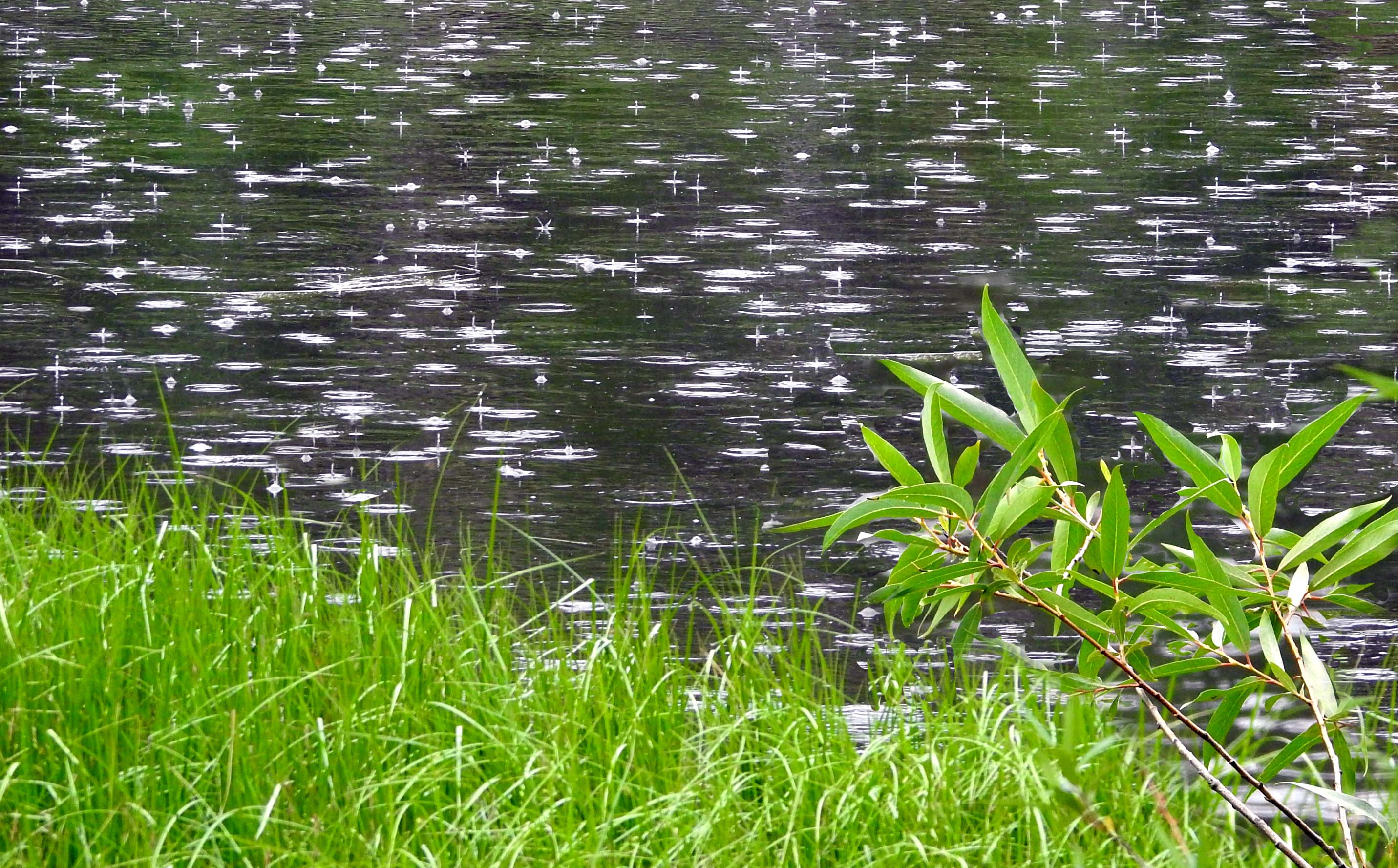
We had stormy weather a week ago, with a total rainfall of .50"!! Yay! This brings our water-year total to 83.53"!!! Yahoo! It poured off and on for days!  A real SOAKER, just when we needed it. The forest was getting crispy! Additionally, this week the temperatures have lowered into the 80's and the nights are in the 50's, such a wonderful change in the weather! I hope the rainstorms keep coming, and keep the fire danger down.


One evening we decided to drive up to the Lakes Basin to see the clouds and rain and sunset skies.  It was gorgeous!  I'm not often up there at that time and it was such a delight!  On our way home we came upon this incredible rainbow,  that lasted for a few glorious minutes!  Such amazing beauty!


On another rainy afternoon in our neighborhood, this beautiful pastel rainbow appeared!  WOW!!!

Who's scat is that?

What's happening in the Lakes Basin?

Check back next week for the answers to these questions and more!

Your questions and comments are greatly appreciated!
Please email me at northyubanaturalist@gmail.com 

Saturday, August 19, 2023

Too Busy to Blog


I'm taking a break from blogging this week, just too much going on! The good news is that we got over half an inch of rain this week, and more is on the way! Yay! Check back next week for my latest natural history news.  Thanks!

Saturday, August 12, 2023

Hiking in the Lakes Basin


The higher elevations in the Lakes Basin are mostly free of snow and currently in full bloom! I hiked in the Lakes Basin five times in the past two weeks, re-visiting areas that had previously been snow covered, as well as areas I hadn't been to this year.  It was glorious!  I love the dramatic giant boulders, sculpted peaks, cascading hemlock forests, and rock covered slopes of the higher elevations. 
 

Hiking off-trail and exploring new areas is also delightful!  I just love taking off up a rocky slope to see what's growing and living there!  I never know what I might find!


 We visit one off-trail area every year, to see the blooming Sierra Primrose flowers. These flowers are endemic to California, found only in the Klamath and Sierra mountain ranges.  The plant is a "subshrub", or a dwarf shrub that is only woody at its base.  Shrubs can be deciduous or evergreen. It grows at 7,000'-12,000' in elevation, usually on damp rocky slopes.  I've only come across it in a few places in the Lakes Basin. 

This year there was still a large, hard-packed field of snow lingering on the ledge where the primroses grow!  More snow than we've ever seen there before! Luckily there were a few small patches of Sierra Primrose flowers in bloom at the recently melted edge of the snow! I also wondered if it is an evergreen shrub, as I could see green leaves under the hard-packed snow. I'll have to come back back again in a couple of weeks to see how the bloom has progressed! This is one of my absolute favorite areas in the Lakes Basin!

un-named lake - 7/30/23

Helgramite Lake Area

I also re-visited the area around Helgramite Lake, that was snow-covered into July!  All the snow is gone now, and the lakes have finally warmed up!

Meadow near Helgramite Lake
Mountain Bluebird (juvenile) - Yellow-rumped Warbler
Sialia currocoides - Setophaga coronata

Near Helgramite Lake is a lovely wet meadow, around 7,000' in elevation, that I love to explore. When I visited it two weeks ago, it was still very wet, and only a few plants were in bloom. There were, however, a good variety of songbirds in the area.

Green Rein/Bog Orchid - Acrid Buttercup - Primrose Monkeyflower
Platanthera sparsiflora - Ranunculus acris - Erythranthe primuloides

I had never seen the Bog Orchid in this meadow before, but there was a nice, small, group of them on the southern end of the wet area.  The Acrid Buttercups weren't carpeting the wet meadow, they were in scattered small groups along the edge.  The Primrose Monkeyflower however, carpeted the wet edges of the meadow.

Alpine Shooting Star - Bog Laurel - Little Elephant's Head
Primula tetandra - Kalmia polifolia- Pedicularis attolens

The Shooting Stars were bordering one area, and almost done blooming.  The Bog Laurel was gorgeously blooming in a few shady areas, and the Little Elephant's Heads were just starting to bloom in the wet meadow.

Chipmunk (species unknown) - Tamias sp.

I was hoping to see a Yellow-bellied Marmot or two, as I usually do in this area, but none were in sight.  I did see several chipmunks scurrying around, eating plants and seeds, and climbing trees.  The species is hard to determine in chipmunks as they look so similar.

Clark's Nutcracker (adults) - Nucifraga columbiana

I was also lucky to see and hear a pair of Clark's Nutcracker up near Helgramite Lake on the same day. We only occasionally see them at the higher elevations in the Lakes Basin. What a treat it was to watch and listen to these raucous members of the Corvid family! The following information is from the website allaboutbirds.org at the Cornell Lab.

"High in the mountains of the West, gray-and-black Clark’s Nutcrackers swoop among wizened pine trees, flashing white in the tail and wing. They use their dagger-like bills to rip into pine cones and pull out large seeds, which they stash in a pouch under their tongue and then carry away to bury for the winter. Each birds buries tens of thousands of seeds each summer and remembers the locations of most of them. Seeds they don’t retrieve play a crucial role in growing new pine forests.

The Clark's Nutcracker feeds its nestlings pine seeds from its many winter stores (caches). Because it feeds the young on stored seeds, the nutcracker can breed as early as January or February, despite the harsh winter weather in its mountain home."

Green-tailed Towhee- Pipilo chlorurus

I saw several Green-tailed Towhees in the area. The "green" is a dull mustard-yellow-green, but the crest of their head is a lovely rusty red.

Green-tailed Towhees migrate up from Mexico to breed in the Sierra Nevada mountains of California, as well as most of the western U.S. They prefer dense, scrubby habitat with a few trees, ranging from 4,000' to 10,000' in elevation. Small insects and berries are their main foods. I always see several of these lovely birds up in the Lakes Basin during the summer.

Olive-sided Flycatcher - Contopus cooperi

I kept hearing a repeated three-note bird call in the forest, and finally spotted an Olive-sided Flycatcher emitting the call!  It also had a HUGE Bumblebee in its beak!  It flew from perch to perch, keeping me in its sight, and the Bumblebee in its beak!  There must have been a nest with nestlings in it nearby, but I didn't see one.  I was more familiar with its other call that sounds like it's saying, "Quick THREE Beers" or "What PEEVES you?"  We prefer to think it's saying "I LOVE you!"

When its nestlings have fledged, this little flycatcher will fly all the way down to Bolivia to spend the winter!

Haskell Peak 5/9/2013 - Haskell Peak Cairn (inset) 8/6/23

Haskell Peak

Last Sunday I hiked up to Haskell Peak, at 8,107', with several friends!  It's a steep, two mile, uphill climb, with a gain of 1,000+' in elevation, but the view is worth it!  Unfortunately, it was hazy and not that great for "vista" photos, but it was still lovely to be up there! I hadn't been up to the peak in ten years, and the rock cairn had changed shape since then!

Brewer's Angelica - Scarlet Gilia - Western Eupatorium
Angelica brewerii - Ipomopsis aggregata - Ageratina occidentalis

All the meadows we encountered on the hike up to the peak were filled to overflowing with flowers!!!  Up near the peak itself were quite a few Brewer's Angelicas, Scarlet Gilias, and a few Western Eupatoriums.  So lovely!

Un-named spring-fed pond

On the way up to the peak, we looked for and found a lovely, small, spring-fed pond that a friend of mine had told me about.  It had lots and lots of tadpoles and other critters living in it, so we stayed, explored the pond, and had our lunch there!

Common Garter Snake - Sierra Chorus Frog - Tadpole unknow sp.
Thamnophis sirtalis ssp. fitchi - Pseudacris sierra - unknown sp.

This Valley Garter Snake is not poisonous, but can bite! They tend to live near wet areas where they eat fish, toads, frogs, tadpoles, salamanders, birds, small mammals, earthworms, slugs and leeches. 

There were a zillion tadpoles and lots of tiny frogs in the pond. Pacific Tree Frogs breed from January to May. The female lays an egg mass containing 10-70 eggs. It takes about 3-4 weeks for the eggs to hatch. The colder the water is, the longer it takes for the eggs to hatch. This is the embryonic stage of a frog. Once they hatch, they will remain tadpoles for approximately 3 months before they are fully formed adults!!

We also saw some salamander larvae, but I couldn't get a photo of them!

Lost Lake - 8/2/23

Lost Lake

My friends and I hiked up to Lost Lake, around 7,000' in elevation, about a week ago.  It is a smallish pond, that totally dries out every year.  This year there was lots of water and lots of critters in the pond! We spent a delightful hour watching all the aquatic invertebrates, including tadpoles, damselfly nymphs, fairy shrimp, and Southern long-toed Salamander larvae!

Spiny-tailed Fairy Shrimp - tadpoles sp.? - Damselfly nymphs sp.?
Southern long-toed Salamander larva
 Streptocephalus sealii - sp? - sp? - Ambystoma macrodactylum sigillatum

I wrote all about these aquatic invertebrates in my blog "Ponds and Lakes", August 24, 2019.  Check it out for tons of information on these critters and more!

Applegate's Paintbrush - Hoary Asters - Leopard Lilies
Castilleja applegatei - Dieteria canescens - Lilium pardalinum

The meadows were incredible on the way to Lost Lake, just a tangle of wildflowers!!!  It is an unbelievable wildflower year!

Sooty Grouse (female and juvenile) - Dendragapus fuliginosus

To our total surprised we flushed out at least 5 Sooty Grouse while we were hiking along the trail, probably an adult with juveniles!  They were too quick for me to get photos.  The photos above were taking two years ago in the Lakes Basin. 

These birds are large, with a length of 17-22", a wingspan of 26", and a weight of 2.3 lbs. I loved the intricate feather pattern, that definitely provided camouflage. They are listed as "uncommon" in our area, although they live here year round. In the winter adults and juveniles feed exclusively on conifer needles. Right now they're eating the leaves and flowers of herbs; leaves, flowers, and berries of shrubs; conifer needles; and invertebrates. What a delight it was to see them!  WOW!!!

Ok, this week I promise to spend some time on the North Yuba River, 
and I'll let you know what's going on!

Check back next week for the latest natural history news in my area!

Your questions and comments are greatly appreciated. Please feel free to email me at northyubanaturalist@gmail.com. Thanks!