Saturday, November 13, 2021

Canyon Creek Trail

Giant Chain Fern - Black Oak & Dendroalsia Moss
Woodwardia fimbriata - Quercus kelloggii - Dendroalsia albietina

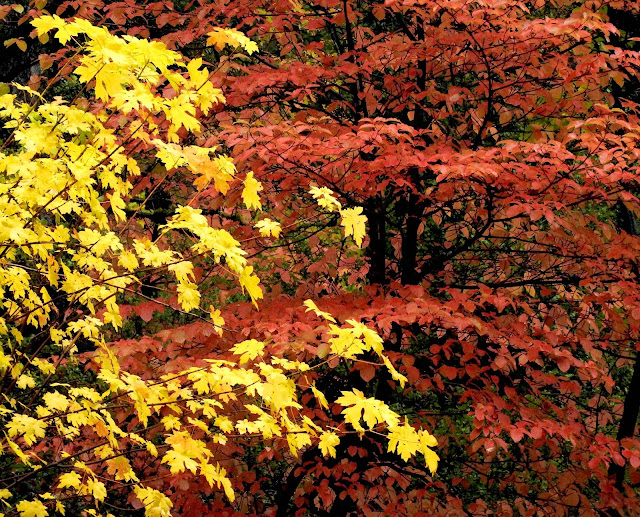
On Thursday, a group of us hiked the Canyon Creek Trail, which follows the North Yuba River for approximately 3 miles to its junction with Canyon Creek.  It's around 2500' in elevation, damp and moist at this time of year, and forested with Madrone, Big-leaf Maple, Tanoak, Black Oak, Incense Cedar, and Douglas Fir. Right now the trailside rocks are covered in lush Dendroalsia Moss, mushrooms have popped up everywhere, and Giant Chain Ferns are flourishing on the banks.  The deciduous trees had created a carpet of colorful leaves on the forest floor which glowed in the late afternoon sun. It was gorgeous!

Orb Weaver Web & Tangle/Cobweb

As soon as we started our hike, spider webs caught our eye!  They were incredibly bejeweled with dewdrops!  Just gorgeous!!!  Spider webs are pretty incredible structures.  Spider silk is a protein fiber that varies in structure (up to 7 different kinds) depending on its use!  Most silks have exceptional mechanical properties, including high tensile strength and extensibility.  A given weight of silk is five times stronger than the same weight of steel!  Some spiders repair their webs at night.  Others eat their web and rebuild it daily! Some spiders, such as the Crab Spider, don't build webs at all and rely on camouflage and ambush to catch their prey!

The Orb Weaver web above was made by a female spider. The female spider doesn't get stuck in her own web because she mainly travels on the non-sticky structural lines. Sometimes she has to walk on the sticky spiral lines, but her hairy legs have an oil that keeps them from sticking! Male Orb Weavers don't make webs.  They spend their time cruising for females to mate. At this time of year, the females are laying their last clutch of eggs, and will die at the first frost.  The eggs will overwinter, up to several hundred eggs in one egg sac, and hatch in the spring.

Sheet Web

There  were lots of these sheet webs in the dry grasses, often in clusters.  There are over 4, 600 species of sheet web weavers in the world!  They are very tiny and don't use sticky thread, but rather entangle and snare prey in their dense webs.  

The following information describes the five main types of spider webs and is  from http://ffden-2.phys.uaf.edu/webproj/212_spring_2019/Rose_Peters/rose_peters/spiderwebs.html

"There are five basic types of spiderwebs, each unique to a distinct species of spiders. The parts that make up a spider web can be summed up as such; two different types of silk, one being dragline silk which are the radial threads from the outer edges of the web to the center. Capture silk is the second, and these threads are what absorb momentum when prey collide with the web.

Spiral Orb webs are the most commonly known, made by orb weavers. These webs are made with two spirals, the first being a non-sticky basic web, the second covered in adhesive. Once the adhesive spiral is complete the spider removes the initial spiral. The appearance of these webs looks like a wheel with spokes.

Tangle/Cobwebs are typically associated with the Theridiidae family (black widows or house spiders, for example.) These webs lack symmetry and are simply several jumbled threads supported by a base.

Sheet webs are horizontally spun, flat sheets of silk between tufts of grass or tree branches. These webs are made with individual strands or are woven as a thick sheet of silk, and the spider will also spin separate criss-crossed threads about the sheet. Some of the spiders associated with this web type include the bowl and doily spider, and the filmy dome spider.

Funnel webs generally hidden between rocks, close clusters of vegetation, or any area that provides a decent amount of shelter. These non-sticky funnel-shaped webs are used as burrows for the spider, and are typically inhabited by multiple families (Agelenidae, Dipluridae and Hexathelidae) one example would be the hobo spider.

Tubular webs are similar to funnel webs in the way that they are typically found on the ground or along the bases of trees. These webs are just as they are named, tubes of web that are used as a hiding place until something triggers a thread radiating from it."

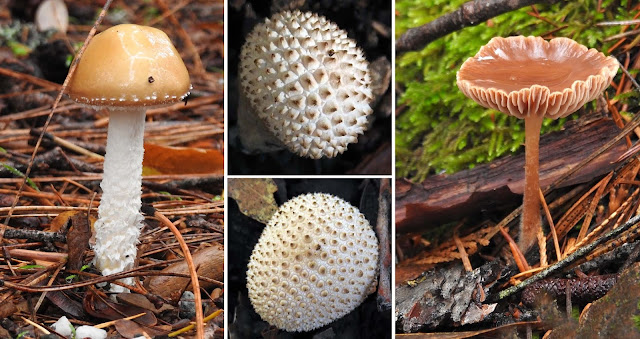
 unknown mushroom - unknown mushroom - Questionable Stropharia

 The spider webs were mainly out in the sunny areas.  As soon as we were in the shady, damp forest we started to find lots of different mushrooms!  Once again, none of us knew the names of most of them, but we enjoyed seeing them!
 
 unknown mushroom - Turkey Tails - unknown mushroom

 Convergent Ladybird Beetles - Hippodamia convergens

 When we got the the end of the trail, there were thousands of Ladybird Beetles on the rocky point where the North Yuba River and Canyon Creek join together. Every fall I've hiked here, ladybugs have always been present! I always am so pleased whenever I see natural events reoccurring! 

The word "bug" is commonly used as a name for any insect. However, Ladybugs are not true bugs, they're beetles! A more scientifically correct name for them is Ladybird Beetles. Every year 1,000's of these Ladybird Beetles converge to mate on this rocky, sunny, point. They remain here throughout the winter and return to lower elevations in the Spring, when temperatures warm up. Like most over-wintering insects, they replace any water in their body fluids (hemolymph) with an anti-freeze during the winter. This prevents any frost from forming within their cells and causing damage. There aren't many predators of ladybugs, as they secrete a noxious fluid that makes them unpalatable.

Sierra Newt - Taricha torosa

After spending some time at the confluence, we headed back to the trailhead.  On the way, my friend Diane spotted some wonderful critters!  First she saw two different California Newts crossing the trail!  Apparently the warmer temperature made them become active!  Their mating season should be over by now, so maybe they were out just looking for the perfect place to overwinter, usually under some forest duff or fallen log.  Not many animals prey on newts, as they are poisonous. However, garter snakes are known to develop a tolerance to the newt's neurotoxin, tetrodotoxin!  Handling newts does NOT expose you to this toxin, but eating one could kill you!  We left the two we saw alone, but were thrilled to see them!

Northwestern Fence Lizard (male) - Sceloporus occidentalis occidentalis

Diane also spotted a dead lizard that tiny ants were feasting on!  This was so cool, as I'd never seen the blue belly of a Northwestern Fence Lizard before!  I've been so hesitant to catch one and look at its belly.  So this was great!  The blue was a BRILLIANT royal blue, accented by the pale yellow under arms and striped thighs!  We'll never know why the lizard died.  Perhaps a bird nabbed it and then got interrupted in its meal.  In the meantime, it was amazing to see its beautiful colors! 

North Yuba River from the Canyon Creek Trail - 11/11/21
 
By the time we got back to where we parked our cars, a heavy mist was on the river, and it was getting dark.  After hugs all around, I headed home, my mind filled with the sights we'd see that day. Such beauty, such wonders!

Dyer's Polypore (side view & top view) - Phaeolus schweinitzii

 Polypore Update!

Ever since I found this Polypore, I've been photographing its development.  It's happening pretty fast!  I'll keep photographing it every couple of days until it's "mature", and maybe even after that!  Here's the first series of photos.  Enjoy!

the same Dyer's Polypore (top view) - Phaeolus schweinitzii
1 day later - 2 days later - 5 days later

the same Dyer's Polypore (top view) - Phaeolus schweinitzii
9 days later!

Sierra Buttes from the Tamarack Connection Trail - 11/6/21

Lakes Basin Update!

I've been on several hikes in the Lakes Basin and near Sierra City lately.  Here are three different views of the Sierra Buttes that I enjoyed!
 
Sierra Buttes from Sierra City - Sierra Buttes from the Love's Falls Trail

Fall Dogwood in the Rain

Damp Earth Art

We got another 2.18" of rain this week! Yahoo!!! The river has risen to 5.7' and running at a rate of 1,617 cfs! Hopefully we'll get more rain soon! Thanks to all of you who contributed art, thoughts, and wishes to this "rain dance"! It's been fun! I'm going to keep posting rain inspired writings, art, etc. on my blog at dampearthart.blogspot.com. Check it out and pray for rain!

This is a Snow Plant sprouting in November!

How are the mosses and lichens?

What kind of ferns are thriving?

What kind of birds have arrived for the winter?

Check back next week for the answers to these questions and more.

Unfortunately, you can no longer sign up to get my blog via email. Just go to northyubanaturalist.blogspot.com directly. It looks better than the emailed version!

Your questions and comments are greatly appreciated. Please feel free to email me at northyubanaturalist@gmail.com. Thanks!

Friday, November 5, 2021

Because of the Rain!

Dyer's Polypore - Phaeolus schweinitzii

Mushrooms are popping up all over the place, lichens and moss are springing back to life, ferns are sprouting, raptors are spreading out their feathers to dry, and ducks are on the pond again, all because it rained heavily a week ago!  It's amazing how quickly our local ecosystem has changed over this past week!
 
I came across this very unusual fungi in my neighborhood this week. They kind of looked like muffins with a lightly broiled, cheesy-cauliflower topping! They were only about 1.75" tall, and didn't have any pores, gills, or teeth! I carefully looked through my field guide, page by page, but couldn't find a match! Then I posted the photos on iNaturalist.org, but no one identified them! So I sent photos to two friends, who then sent them on to the same mycologist, an Assistant Professor at CSU East Bay University, and bingo he identified them as VERY YOUNG Dyer's Polypores - Phaeolus schweinitzii. Mystery Solved! How cool! Apparently they don't look at all like the mature polypores, that are large and round, like a fluted plate! No wonder I couldn't find them in the field guide!  I'm going to photograph their development and post it in a future blog!

Boletes - unknown mushroom - Puffballs

I spent several hours this week searching for mushrooms in the local woods.  I found hundreds of them!  However, I'm not good at identifying the majority of mushrooms I find.  There are SO many kinds of mushrooms (an estimated 3,000-4,000 species in California), and many of them also vary greatly in color and shape during their lifespan, that I usually find them difficult to identify. Unless of course it's a very common one that doesn't vary much and looks just like one of the photos in a field guide (in my dreams!). Therefore I haven't identified most of the ones pictured here. Every year I learn a few more, so in 20 years I'll be able to identify...

Questionable Stropharia - Puffballs - unknown mushroom

Even though I don't know the proper name of most mushrooms, I find it really fun to go out looking for them. I enjoy their unusual shapes, textures, sizes, and colors. The main part of a mushroom is a web of fine white threads called mycelium, usually found underground. The individual threads are called hyphae. This is the part of the mushroom that digests nutrients and can also create a mycorrhizal relationship with trees. Additionally, when a male hyphae and a female hyphae meet underground, they fuse together and produce a mushroom. Mushrooms are the fruiting bodies of the mycelium.

unknown mushroom -  emerging Amanita - older Amanita (species unknown)

If you want to eat mushrooms you really need to be able to identify them precisely.  Several deadly-poisonous mushrooms look just like non-poisonous mushrooms.  Before you eat any mushrooms, I highly recommend taking a mycology class, or taking a mycologist with you into the field!  There are also many excellent mycology websites online. My favorite is mykoweb.org, which has photos and text for 831 of the California mushroom species! 

Banana Slug feasting on a Bolete!

A variety of critters are fungivores (eaters of fungi), such as the Northern Flying Squirrel, deer, mice, voles, squirrels, beetles, and even banana slugs!  It appeared to me that the favorite mushroom for slugs and other critters with teeth were the Boletes!  I came across several areas of the forest, which I named Bolete Buffets, that were littered with dozens of chewed up boletes on the ground! Boletes have pores, that are actually tubes lined with spores, instead of gills.

Sharp-shinned Hawk - Accipiter striatus

I saw a juvenile Sharp-shinned Hawk perched in the big cedar at the cemetery one morning this week!  It had rained overnight, and it was spreading out its tail feathers and wing feathers to dry!  Just beautiful!  It's probably the same one I've been seeing lately.  There was also one perched outside an upstairs window of our house this week!  Didn't get that great of a look, or photo, to see if it's the same one.  It probably was, as there aren't usually several hawks of the same species in our neighborhood.  There's not enough food for more than one!

Hooded Mergansers (2 males - 1 female - 1 juvenile) 
Lophodytes cucullatus

Joubert's Diggins

We stopped at the local pond again this week and to my delight there were several different ducks present!  The water had clearly risen from the rain, and its clarity was way better.  You could even see the underwater green plants!

Hooded Mergansers are listed as visiting our area in the Winter, or non-breeding season! They primarily breed up north in Canada. Classified as diving ducks, Hooded Mergansers eat small fish, aquatic insects and crustaceans, particularly crayfish. They have serrated bills for grasping and handling slippery prey. Their eyes are specially adapted to see underwater.  I've seen Hooded Mergansers on this pond before!  So nice to see them back again, and with a small juvenile!

Mallard (male-females) - American Coot - Ring-necked Duck
Anas platyrhynchos - Fulica americana - Aythya collaris

I spotted the sleeping Mallards because of their reflection in the pond.  I've seen Mallards on this pond year-round, often with their ducklings in the summer.  

The American Coot has been here a few weeks!  It was fun to watch it cruise around with the Hooded Mergansers!

The Ring-necked Duck is probably another winter visitor to our area, as most of these ducks breed in northern Canada. However, some stay in our area year-round and raise their ducklings locally.  I've never seen a Ring-necked Duck on this pond before!

Fiberfill from a garden scarecrow in an Oriole nest!

Damp Earth Art

We got another .32" of rain this week, on Sunday and Thursday, and more is on the way.  Yahoo!!!  Thanks to all of you who contributed art, thoughts, and wishes to this "rain dance"! It's been fun! I'm going to keep posting rain inspired writings, art, etc. on my blog at dampearthart.blogspot.com. Check it out and pray for rain!

What kind of plant is this?

How are the mosses and lichens?

Are there any insects around?

What's happening in the Lakes Basin?

Check back next week for the answers to these questions and more.

Unfortunately, you can no longer sign up to get my blog via email. Just go to northyubanaturalist.blogspot.com directly. It looks better than the emailed version!

Your questions and comments are greatly appreciated. Please feel free to email me at northyubanaturalist@gmail.com. Thanks!


Saturday, October 30, 2021

12.3" of Rain!!!

Red-tailed Hawk in the Rain - Buteo jamaicensis

Rain started falling last Thursday and didn't stop until Tuesday! The total precipitation for the storm was 12.3"!!!  Most of the rain, 7.9", fell on Sunday!  IT POURED!  It was fabulous! We haven't had heavy rainfall like that for years and years!  It has washed away the threat of wildfires in our area!  What a miracle!!! 

The storm was part of an "Atmospheric River" that covered most of California, with the northern part receiving the most rain.  The following is NOAA's simple description of an atmospheric river.

"Atmospheric rivers are relatively narrow regions in the atmosphere that are responsible for most of the transport of water vapor from the tropics. Atmospheric rivers come in all shapes and sizes but those that contain the largest amounts of water vapor and strongest winds are responsible for extreme rainfall events and floods. This type of hydrologic event can affect the entire west coast of North America. These extreme events can disrupt travel, induce mudslides, and cause damage to life and property. Not all atmospheric rivers are disruptive. Many are weak and provide beneficial rain or high elevation snow that is crucial to the water supply."

Red-tailed Hawk - Red-shouldered Hawk
Buteo jamaicensis - Buteo lineatus

After the Storm

I saw the Red-tailed Hawk in the top of a pine tree during a heavy rainstorm in 2019.  This week, after the storm passed, I was lucky enough to see two different hawks spreading their wings to dry out in the sun. The Red-tailed Hawk pictured on the left was near the Open Slope that I often write about.  The Red-shouldered Hawk on the right was on my neighbor/fellow naturalist's property! It made me wonder how birds stay dry in wet weather.

The following information is from birdwatchingpro.com.

"If you’re an avid bird watcher, then you probably already know that if a light rain is falling, birds will still go about their business as usual. This is because they are designed to have at least some sort of water resistance. Unless it’s a heavy rain, water will generally just slide off the feathers, and their bodies will be kept warm thanks to the air pockets beneath their feathers.

But in the heavier rains, most land birds will seek shelter from the storm. Small bushes, shrubs, thickets, or even some trees will provide excellent shelter from heavy rain. In order to maintain their body warmth for as long as possible, the birds will stay still and conserve their energy.

If the rain does not cease, then the birds will eventually run out of energy. So, they will have to venture out and find food to fuel their energy. Birds that feed on insects may have a tough time finding grubs while it is raining, but they tend to be spoilt for choice after the rain.

Raptors may also suffer during prolonged periods of rain. Birds that feed on seeds and worms will be okay for food, especially since heavy rains tend to unearth worms. If a storm rages on for a prolonged period of time, then raptors and insect-eating birds will suffer greatly and face hypothermia and even death."

The following additional information is from gckcopywriter.com.

"Raptors like rain about as much as a cat likes a bath.

Hawks, eagles, owls, and other birds of prey have a tough time during drenching rains.

First, depending on their size, a raptor’s wings can take as much as an entire day to dry out. Before that, it’s too difficult to fly any normal distance to find food.

Second, even if they can fly normally, their prey – whether its smaller birds, rabbits, or squirrels – take shelter against storms in dense surroundings or burrows. They stay hidden.

If it rains too long, raptors can be faced with a serious lack of food and face a real crisis."

North Yuba River 10/23/21 

The River!

Before the storm came, the North Yuba River was very shallow and slow.  There was a good sized rock bar that was visible downstream, with willows growing on it.  During the height of the storm that rock bar was totally submerged!
 
North Yuba River 10/26/21 

Over the course of the storm, the  river rose from 1.4ft to 11.3ft in height. That's a difference of almost ten feet!!!  It has since dropped back down to 3 feet in height.  The cubic-feet-per-second (cfs) rate rose from 90cfs to 7,925cfs, at the height of the storm!  It has since dropped down to 420cfs!  It was amazing to see!  The last "high water" I remember was in 2017!
 
Wood Duck (male) - Aix sponsa

Before the Storm

The day before the storm arrived I was down at the bridge in the early evening and just happened to spot a male Wood Duck swimming by!  Wow!  I have only seen these ducks on ponds, so it was a complete surprise to see one on the North Yuba River! It quickly took off downstream when it saw me, so I only got a few blurred photos. (The photo above was taken on a pond in the foothills last spring.)

Wood Duck (male) - Aix sponsa

Adults feed mainly on acorns off the ground, but will also forage for invertebrates and aquatic plants. These duck nest in the foothills of the western Sierra, usually below 3,000' - 4,000' in elevation, where there are a lot of oaks and acorns. They are tree-cavity nesters. They use natural cavities that have formed in a mature tree, often where a branch has broken off due to heart rot, as well as abandoned Pileated Woodpecker cavities. The Wood Duck is the only North American duck that regularly produces two broods in one 5-6 month breeding season! The female lays 10-13 eggs in her feather-lined nest, anytime between March and June. The incubation period is 30 days. The ducklings are born precocial, and leave the nest usually within 24 hours after hatching. They jump to the ground and their mother leads them to water, where they immediately start feeding! After approximately 30 days, the female abandons the young ducklings, to start another brood!

Common Merganser (female - male) - Mergus merganser

Earlier that day we also spotted several Common Mergansers on the river!  We hadn't seen any for three weeks.  At this time of year the males are molting and getting their mating plumage back.  Their bright white breasts and bellies are a striking contrast to their dark heads.  We haven't seen them since the storm came through.  They must seek out ponds and slow moving side streams during periods of heavy rain and high water.

Columbian Black-tailed Deer - Odocoileus hemionus columbianus
inset: American Black Bear scat


Wild Rose in the Rain

Damp Earth Art

 Thanks to all of you who contributed art, thoughts, and wishes to this "rain dance"!  It's been fun!  I'm going to keep posting rain inspired writings, art, etc. on my blog at dampearthart.blogspot.com. Check it out and pray for rain!


What kind of Mushrooms are popping up?

Are the lichens active again?

Check back next week for the answers to these questions and more.

Unfortunately, you can no longer sign up to get my blog via email. Just go to northyubanaturalist.blogspot.com directly. It looks better than the emailed version!

Your questions and comments are greatly appreciated. Please feel free to email me at northyubanaturalist@gmail.com. Thanks!
Saturday, October 23, 2021

Fall Color!

Aspen leaves in a partially frozen puddle

Last Sunday night, it started raining around 9:00 pm, and kept up all night!  It poured!  Our precipitation total, by 10:00 am on Monday morning, was almost .75" of an inch!  Heavy rain is predicted to start tonight and continue through Monday, with a possible precipitation total of 8-10"!!!  Yahoo!  My fingers are crossed. This could very well be the end of the fire season in our area!  In fact most of California is getting some of this heavy rain! Thank goodness!  Rain, rain, come on down...
 
 Aspen Meadow 10/18/21  - 10/10/18

On Tuesday we decided to drive up to the Lakes Basin to check out the aspens one last time before the rains came.  We went to our favorite aspen-rimmed meadow for our annual picnic and were surprised to see about two inches of snow on the ground!  It was so beautiful! 

Sierra Buttes 10-19-21

We went to several other areas where there are aspens, and saw the newly 
snow-dusted Sierra Buttes from different vantage points.  Such beauty!  What a relief to get this weather!  It's been a tough couple of years for all of us with Covid-19, wildfires, and horrendous smoke on top of all our normal day-to-day stresses.  Now this snow and rain will literally and figuratively make us breathe easier! I am so grateful!

Black Oaks on Highway 49

A Scenic Drive on Highway 49

It's about a 45-60 minute drive from our area up to the Lakes Basin, and a climb in elevation of about 2,500'-3,000'. For most of the drive, the beautiful North Yuba River is alongside the highway. It's always a lovely drive, but right now the Fall colors are spectacular despite the drought.  I think the main reason that the leaves didn't just dry up is that it rained a little in our area, every week for the past 5 weeks. Apparently it was just enough rain to keep the leaves from drying out!  Additionally the river kept the canyon cool and damp, and kept plants from drying out.  Anyway it's a gorgeous drive. Here are some photos of the beauty!  Enjoy!

Fremont Cottonwoods on the North Yuba River
Populus fremontii

Big-leaf Maple & Mountain Dogwood
Acer macrophyllum - Cornus nuttallii

 California Black Oaks - Quercus kelloggii

Indian Rhubarb - Darmera peltalta

 Western Gray Squirrel - Sciurus griseus

What are the Squirrels doing?

Right now the Western Gray Squirrels are eating and storing as much food as possible for the winter. At this time of year they mainly eat mushrooms, mistletoe berries, acorns, pine nuts and seeds. They search for food daily, but also have small caches of food to eat when snow blankets the ground. During winter they usually live in a hollow tree or limb, or abandoned woodpecker cavities.

Chickaree/Douglas Squirrel - California Ground Squirrel
Tamiasciurus douglasii - Sciurus griseus

Chickarees/Douglas Squirrels are also eating and storing as much food as possible for the winter. A Chickaree might build a ball-shaped nest out of twigs, lichen, shredded bark (and apparently polyester fiberfill) up in a tree for the winter. Or it might live in a woodpecker nest or hollow log for the winter.  They and the Western Gray Squirrel are called "scatter hoarders", because they stash food in many places, not just one spot. They are incredible tree climbers and acrobats, and can rotate their hind feet 180° backwards when climbing down a trunk. Pine Martens, Bobcats, foxes, owls, and Goshawks are their predators. Pine Martens hunt mainly on the ground for rodents at night, but will also pursue prey in trees. Goshawks are diurnal forest hunters, and Chickarees are their preferred prey! Bobcats are nocturnal and mainly hunt for prey on the ground, but can also easily climb trees. 

Unlike the Chickaree and the Western Gray Squirrel that stay active throughout winter, California Ground Squirrels hibernate in winter, so right now they are eating and bulking up as much as possible. Their diet consists of primarily seeds, including acorns, insects when available, berries, roots, and bulbs.  They will also cache some food in their underground burrow. These squirrels are highly adaptable, and live at elevations from 0 - 7,215'! They prefer to dig their underground burrows on the edges of open areas, such as meadows or fields.
 
seeds, barley, oats, and acorns (Quercus): valley oak, blue oak, coast oak). They also eat fruits, like gooseberries and pears, and quail (Callipepla) eggs. They include insects in their diets when they are available, and have been known to eat grasshoppers, crickets, beetles and caterpillars. They also eat roots, bulbs, and fungi, such as mushrooms.
 Joubert's Diggins

 Depot Hill Pond

Smoke has kept me from stopping and checking out one of the local ponds.  The other day was overcast and smoke free, so I stopped by for a visit.  To my delight the cattails had turned and the pond looked beautiful.  On the far distant edge I spotted a lone American Coot in the water!  The forecasted rain will bring the water level back up and then maybe more waterfowl will show up.

Cattails and reflection of the Sky

The cattails and the reflection of the brilliant blue sky and clouds were stunning!  I'll have to stop by again next week!

Manzanita leaves beaded with Rain!

Damp Earth Art

It may be the beginning of the rainy season!  We've been in a 5 day rainstorm and more is expected next week!  I'll post the total precipitation next week.  The river is up, and the earth is damp and fragrant! Perhaps our wishing for rain helped!  Thanks to all of you who contributed art, thoughts, and wishes to this effort!  It's been fun! 

Check out my blog at dampearthart.blogspot.com where I post photographs, quotes, and artworks that feature rain.


What's happening with the Deer and Bear?

What's happening with the moss and lichen?

Are mushrooms popping up?

Check back next week for the answers to these questions and more.

Unfortunately, you can no longer sign up to get my blog via email. Just go to northyubanaturalist.blogspot.com directly. It looks better than the emailed version!

Your questions and comments are greatly appreciated. Please feel free to email me at northyubanaturalist@gmail.com. Thanks!