Friday, April 9, 2021

Nesting Time!


American Dipper at nest - Cinclus mexicanus


American Dippers are building a nest!


To my delight I came across a pair of American Dippers building a nest this week! Both the male and female were participating in the nest building. However, the female does most of the building and the male assists. As I watched, one would land with a beak full of moss and lichen. If the nest was empty, and it was presumably the female, it would go straight in. When the male landed it would wait outside until the female took the lichen/moss that it had brought, or it would just leave the nesting material and fly away! Their nest was large, about 10'' wide and 8" tall! Dippers make their igloo-shaped nest with a thick outer layer of moss, and a 5.5" inner chamber, globular in shape, composed of grass and leaves. I couldn't find the exact length of time it takes for them to build a nest, but I would imagine it would be at least a week or two. 


American Dipper at nest - Cinclus mexicanus

This nest was built on the ledge of a bridge pillar, out in the river, about 20' above the river.  The Cornell Lab of Ornithology states: 

"Natural sites commonly include cliff ledges and cliffs, behind waterfalls, under boulder piles, midstream boulders.  Occasionally among roots, in hollow tree stumps, and under overhanging dirt banks.  Readily uses human-made structures: under bridges, dam spillways and sluiceways, culverts, and buildings. Uses nest boxes placed on midstream stake or under bridge, if inaccessible to predators. Basic requirements for nest sites: close to water (usually fast water, usually with high noise level), inaccessible to predators, protected from floods, and a horizontal ledge or crevice for support. Locations close to fast water or deep water augment inaccessibility."


American Dipper at nest with nestlings - Cinclus mexicanus

4-5 eggs will be laid a week or two after the completion of the nest. The female does all the incubation for 14-17 days. The male feeds the female while she is on the nest. She also feeds herself. Young are born altricial, and remain in the nest for approximately 25 days. Both the male and the female parents feed the nestlings. Fledglings can feed, bathe, and have limited flight within one day after leaving the nest! Parents keep feeding fledglings for 4-35 days. Juveniles beg for food by fluttering wings rapidly, calling loudly, dipping, and then raising their head and gaping. Even when capable of foraging for itself, a juvenile follows its parents and waits for the parents to bring food. Forty-five days after fledging, the juveniles disperse into the wild!


American Dipper Nest

Last year I saw a nest in the exact same location, with nestling American Dippers in it! I watched the parents feed them on many occasions! Unfortunately, in the Fall the nest was no longer there. Someone must have taken it. It may seem tempting to collect bird nests, however it is totally illegal! The Migratory Bird Treaty Act of 1918 states, “No person may take (kill), possess, import, export, transport, sell, purchase, barter, or offer for sale, any migratory bird, or the parts, nests, or eggs of such bird except as may be permitted under the terms of a valid permit." It is also illegal for anyone to keep a nest they take out of a tree or find on the ground unless they have a permit issued by the U.S. Fish and Wildlife Service. So bring your camera or binoculars and enjoy what you see, but please leave wild things wild!

 
Downy Woodpecker (male) - Dryobates pubescens

Lots of other birds are building nests locally!  I've been seeing Robins, Steller's Jays, Brewer's Blackbirds, and Woodpeckers busy at their nest sites.  To my delight the Downy Woodpecker that nested in a snag outside my window last year has returned!  I saw him hammering on the same snag on April 2nd, just one day later than last year!  He hasn't been back every day, but every once in a while he shows up and starts hammering.  It would be so cool if the two Downy Woodpeckers nest there again.  It was fascinating watching them excavate the nest, chase off an intruding Starling, and feed their nestlings.  I'll keep you posted on what develops.  In the meantime you can read what happened last year in my May 9 and June 14 blogs. 
 

Brewer's Blackbird (female) with nesting material
Euphagus cyanocephalus


Steller's Jay with nesting material
Cyanocitta stelleri


Sierra Gooseberry - Ribes roezlii

Our local flora is gradually starting to bloom. One afternoon we came across this beautiful blooming Sierra Gooseberry!  What a surprise!  The flowers are wind pollinated, and don't rely on insects for fertilization.  It will produce round, reddish, bristly berries, that are eaten by Black Bears, rodents, Mule Deer, and birds.


Brewer's Rock Cress (?) - Sicklepod Rock Cress
Boechera breweri (?) - Boechera sparsiflora

Along the highway I found ONE purple Brewer's Rock Cress in bloom. Further up the road, I came across a dozen or more Sicklepod Rock Cress plants.  The Sicklepod flowers are tiny, and the whole plant is well camouflaged against the rocks. The  Brewer's flowers were thumbnail size and much showier.  Both plants are in the Mustard family, Brassicaceae, with flowers that have 4 petals. 


California Saxifrage (?) - Silk Tassel Bush
Micranthes californica (?) - Garrya fremontii

California Saxifrage was the first plant that bloomed on the Canyon Creek Trail.  You can find it blooming on the sunny, rocky seeps along the trail.  The Silk Tassel Bush finished blooming a few weeks ago.  These bushes are dioecious.  The one I found in bloom was a female!  The individual flowers are amazingly intricate, and together form a long hanging raceme.  Just gorgeous!


Kellogg's Monkeyflower - Vari-leaf Collomia
Diplacus kelloggii - Collomia heterophylla

I found a few Kellogg's Monkeyflowers up a wet slope at Canyon Creek.  With a hand lens the color is amazing, as are the stamens and pistils!  The Vari-leaf Collomia flowers are just a little bit bigger than a ladybug!  Tiny, but again,
lovely with a hand lens!  


Northern Flicker (female) in Cherry Tree - Colaptes auratus

More Damp Earth Art!

Since we are indeed in a drought situation, I am continuing to maintain this blog and am again sending out another "Call for Art" in celebration of rain. My intention is to focus on the need for rain, and through collective positive energy invoke rain to fall. It is just a wish, a thought, and a hope. If you would like to submit some art, or writing, or a photo please email me at northyubanaturalist@gmail.com. Check out what's already been submitted at dampearthart.blogspot.com

You can view what was submitted last year at dampearth.blogspot.com.
I will be posting new art weekly. Check it out and pray for rain.


Sierra Valley - 4/8/21

What's happening in Sierra Valley?

What kind of insects are out and about?

What birds have recently arrived?

Check back next week for the answers to these questions and more!

Unfortunately you can no longer sign up to get my blog emailed to you.
Something changed at Blogspot.com. Oh well... However, my blog looks better if you just go to northyubanaturalist.blogspot.com, rather than get the emailed version. I suggest that you just bookmark my blog and visit it every Sunday afternoon!

Your questions and comments are greatly appreciated! Please feel free to email me at northyubanaturalist@gmail.com. Thanks!

Friday, April 2, 2021

More Wildflowers!


The Landscape

This week I went to North Table Mountain Ecological Preserve with some friends to see the spring wildflowers. It is a flat-topped butte, next to the town of Oroville, Ca., the top of which is capped by an ancient lava flow. It became an ecological preserve in 1993, when Francis Carmichael, a local rancher, sold 3,315 acres of it to the State of California, to be managed by the California Department of Fish and Wildlife. Now it is open to the public. Some cattle are allowed to graze there in the wet months, but apparently cause little impact on the native wildflowers.


There are a few trails you can follow, but usually we just amble across the reserve through acres of wildflowers that are ribboned with small streams. It is easy walking with panoramic views in all directions!


Sky Lupine - California Goldfields (background)
Lupinus nanus - Lasthenia californica ssp. californica

The Flowers!

This year the wildflower bloom was unbelievably spectacular!  Great swaths of yellow, blue, orange, magenta, and white covered the 3,000+ acres of the preserve! This year is the most profuse bloom I have ever seen here!  There were billions of flowers blooming, carpeting the whole preserve!  I was totally entranced! Approximately 400 species of wildflowers thrive on North Table Mountain, 74% of which are native. Here are just a few of the beauties we saw!  I've featured close-ups for a change.  With a hand lens, an even more astonishing level of beauty is revealed!  I highly recommend getting a 25x hand lens to take in the field. You will be AMAZED!!!


Bitterroot - Lewisia redivia var. rediviva

With a hand lens you can often find tiny beetles in among the stamens!


Table Mountain Meadowfoam - Limnanthes douglasii ssp. nivea

With a hand lens the stripes on the petals are actually "see through"!


Red Maids - Calandrinia ciliata

With a hand lens this flower is super sparkly!


Bird's-eye Gilia - Gilia tricolor ssp. tricolor

With a hand lens, the blue anthers are amazing!


Pink Woodland Star - Lithophragma parviflorum

With a hand lens the hairs on this flower are visible, and glisten in the sunlight!

Sky Lupine - Purple Owl's Clover - Blue Dicks - Foothill Poppy (background)
Lupinus nanus - Castilleja exserta ssp. exserta - Dichelostemma capitatum  Eschscholzia caespitosa

Everywhere we walked there were huge fields of multi-colored wildflowers!  That night the beauty of these wildflowers lingered and lingered in my mind.  I was filled with beauty!


We are going back again next week to explore the canyons and waterfalls that edge the top of the butte!  We'll also take more time to check out the birds!  It should be amazing once again!  I'll report what we find in a few weeks! 
 
 
Pronghorn Antelope - Antilocapra americana

Sierra Valley

I also went for a drive to Sierra Valley with my friend Judy this week!  We were curious to see what birds were back!  It is still dry winter over there, and everything is beige and brown, but the waterways are fuller than last time.  Right away we lucked out and spotted three American Pronghorns in the far, far distance!  Wow!!!  The heat waves coming off the valley floor distorted my photos, but it was such a treat to see these uncommon animals!  We were thrilled!


Coyote - Canis latrans

To our delight we also got a great sighting of a Coyote!  Usually they are super far away and disappear from view very quickly!  This one was out on the edge of a wetlands and took its time trotting away once it saw us!  How lucky we were!  It looked stocky and was heavily furred!  Perhaps it still had its winter coat!


Lesser Sandhill Crane - Greater Sandhill Cranes  
Grus canadensis canadensis - Grus canadensis tabida

We also saw 10 (5 pairs) of Cranes that day!  One of the pairs were Lesser Sandhill Cranes, which we had never seen before! Lesser Cranes are shorter by 5" and weigh 3 lbs. less than the Greater Cranes.  They also have rust-colored bodies in the Summer, as compared to the gray bodies of the Greater Cranes.  They both spend the winter in California's Central Valley.  Some of the Greater Cranes will migrate to SE Oregon, NE California, and NW Nevada to breed.  All of the Lesser Cranes, and some of the Greater Cranes will migrate to the high Arctic and into Siberia to breed! 

We are going back again next week to kayak in the valley!  Can't wait!  
I'll let you know what we see in a few weeks!


More Damp Earth Art!

Since we still need more rain, I am continuing to maintain this blog and am again sending out yet another "Call for Art" in celebration of rain. My intention is to focus on the need for rain, and through collective positive energy invoke rain to fall. It is just a wish, a thought, and a hope. If you would like to submit some art, or writing, or a photo please email me at northyubanaturalist@gmail.com. Check out what's already been submitted at dampearthart.blogspot.com

You can view what was submitted last year at dampearth.blogspot.com.
I will be posting new art weekly. Check it out and pray for rain.


Are anymore plants blooming?

Are birds starting to nest?

What kind of insects are out and about?

Check back next week for the answers to these questions and more!

Unfortunately you can no longer sign up to get my blog emailed to you.
Something changed at Blogspot.com. Oh well... However, my blog looks better if you just go to northyubanaturalist.blogspot.com, rather than get the emailed version. I suggest that you just bookmark my blog and visit it every Sunday afternoon!

Your questions and comments are greatly appreciated! Please feel free to email me at northyubanaturalist@gmail.com. Thanks!

Saturday, March 27, 2021

Blue Oak Grasslands


This week we went down to another oak woodland in the foothills, which is part of the Spenceville wildlife preserve and recreation area run by the California State Department of Fish and Game. I had never been to this area before. Unlike the South Yuba River State Park, cattle roam the Spenceville preserves. The difference in the landscape and vegetation was immediately obvious. There was a definite lack of shrubs and weeds! It was gloriously open with clusters of Blue Oaks on the hillsides, broad open meadows of short green grass, and beautiful wide vistas of the surrounding hills! It was spectacular!

However, instead of cascades of wildflowers, there were scattered thin patches of tiny wildflowers on the grassy slopes, the small creek and scattered ponds were trampled and polluted, and there were cow pies everywhere! Although I am very glad that this oak woodland hasn't been developed for housing, I wasn't pleased with the effects of the cattle. On the internet, there is a LOT of information on the pros and cons of cattle grazing on public lands. It is a very complex issue, with valid arguments from both sides often on the "opposite side of the fence".

and

For the "pros" of grazing I suggest the following websites: https://www.ebparks.org/about/stewardship/grazing/benefits.htm
and


Scattered Wildflowers
 
On the sunny slopes most of the wildflowers were sparsely scattered, and quite tiny.  Surprisingly one area near a pond was carpeted in Frying Pans and Goldfields!  The cattle were right among them, so perhaps these flowers weren't palatable.  So pretty!  


Frying Pans - California Goldfields
Eschscholzia lobbii - Lasthenia californica

All of these flowers were less than an inch in diameter.  Quite little!  The True Baby Stars were only about half an inch across!  It was great to have a hand lens to examine these tiny beauties! 


Butter & Eggs - True Baby Stars - Cowbag Clover
Triphysaria eriantha - Leptosiphon bicolor - Trifolium depauperatum


The Waterways

Most of the canals and small creeks were trampled and polluted.  We were surprised to come across this rather large pond (above) that wasn't too badly damaged!  There were lots of birds in the surrounding reeds and willows and we even saw a turtle (hopefully not a Red Slider!) swimming by!  In another tiny pond, there were surprisingly LOTS of tiny little fish! How they got there, and how they're going to survive is indeed a mystery!


Tiny Fish and Turtle (inset)


The Hillsides and Ridges

As we walked up the hills to the ridgetops we encountered a lot more wildflowers among the ancient looking lichen-covered rocks.  We guessed that the cows can't  easily forage in the rock outcrops, and thus the wildflowers are spared!  The rocks, Blue Oak forest, and wildflowers were absolutely stunning!  We also saw a Coyote run off in the distance!  Too fast and far away for a photo! (Rats!)

Caterpillar Phacelia - Blue Dicks
Phacelia cicutaria - Dichelostemma capitatum

Caterpillar Phacelia - Manroot (fruit) - Dove's Foot Geranium
Phacelia cicutaria - Marah fabacea - Geranium molle

The fruit of the Manroot looks prickly but the spines are soft and pliable.  While we were looking in our field guides, we learned that the origin of the name "Manroot" comes from the fact that its root can reach the size and more or less the shape of a man!  WOW!!!  Never would have guessed that one!


Western Bluebird (male - female)
Sialia mexicana

The Birds!

There were lots of birds in the Blue Oak forests, that were all calling and singing!  It was lovely to hear them!  Other than the Western Bluebirds, I never see these birds in our neighborhood.  We kept hearing a loud repeated call and finally figured out it was the White-breasted Nuthatches! Like the Red-breasted Nuthatches in our area, these little birds climb up and down the trunks and branches of trees, gleaning insects from the surface and crevices.


White-breasted Nuthatch - House Finch (female)
Sitta carolinensis - Haemorhous mexicanus


Lewis's Woodpecker (adult) - Meadowlark (adult)
Melanerpes lewis  - Sturnella neglecta


I really enjoyed our time there, despite the cows!  We probably saw at least 50 cows, but I didn't take a single picture of them!  It was peaceful, beautiful, and so different from where we live!  A lovely, lovely day! 
 
                                                                
                                                                   Spring Umbrellas - ©KoK 2010

More Damp Earth Art!

Since we still need more rain, I am continuing to maintain this blog and am again sending out yet another "Call for Art" in celebration of rain. My intention is to focus on the need for rain, and through collective positive energy invoke rain to fall. It is just a wish, a thought, and a hope. If you would like to submit some art, or writing, or a photo please email me at northyubanaturalist@gmail.com. Check out what's already been submitted at dampearthart.blogspot.com

You can view what was submitted last year at dampearth.blogspot.com.
I will be posting new art weekly. Check it out and pray for rain.

Sierra Buttes and Sardine Lake (frozen) - 3/22/21

Lakes Basin Update

Last Monday I walked up to Sardine Lake on the snow!  The snowmobile track was packed and easy walking.  Off the track I sunk in the snow about 1.5'!  Surprisingly the lake was totally frozen!  It was a gorgeous blue sky day and wonderful to be back up there!  I also drove up to Yuba Pass to see how much snow was there.  On the way, the north facing slopes were still quite snowy!  There was only about 2.5' of snow at the Pass.  So we still have a snowpack, though definitely not a lot.  Sure hope more storms keep coming!


 Dead Man Peak - 3/22/21

Are anymore plants blooming?

What's happening in Sierra Valley?

What kind of insects are out and about?


Check back next week for the answers to these questions and more!

Unfortunately you can no longer sign up to get my blog emailed to you.
Something changed at Blogspot.com. Oh well... However, my blog looks better if you just go to northyubanaturalist.blogspot.com, rather than get the emailed version. I suggest that you just bookmark my blog and visit it every Sunday afternoon!

Your questions and comments are greatly appreciated! Please feel free to email me at northyubanaturalist@gmail.com. Thanks!

Friday, March 19, 2021

In Celebration of Wildflowers!

Miniature Lupine - Tufted Poppy - Lacepod
Lupinus bicolor - Eschscholzia caespitosa - Thysanocarpus curvipes

The local Native Americans, the Nisenan, traditionally celebrated the beginning of Spring with a ceremonial dance called the Weda or Flower Dance in April.  

Local historian Hank Meals states in his Aug. 18, 2018 blog "Foothill Dancers" (yubatreadhead.blogspot.com): "In Yuba River country the indigenous Nisenan people, for reasons both social and ceremonial, have been dancing for thousands of years. Among the events enhanced by dancing were the arrival of spring flowers featuring miles of blooming meadows that are now covered by housing developments. Obviously the Weda was danced outside with the participants wearing flowers. If I could enter a time machine to revisit a historical event this would be it."

Blue Dicks - Fiddleneck - Bird's Eye Gilia
Dichelostemma capitatum - Amsinckia menziesii - Gilia tricolor


"The Valley Nisenan by A.L. Kroeber, 1929:
In Weda feasts-The Nisenan were given to outdoor feasts. They held the yo"we'da and sa"we'da, which were "like picnics," with races, hand-games, play, and a hu'sla or great meal given by the "great people". The yo"we'da was held when all the flowers, yo", were in bloom, and the women wore them on their hair, ears, and hands. The sa"we'da came later in the season, when flowers were gone and everything was in leaf." 

Lacepod - Popcorn Flower - Caterpillar Phacelia
 Thysanocarpus curvipes - Plagiobothrys nothofulvus - Phacelia cicutaria

The following information is from  

"Weda Dance - Exact details of this dance were not obtained, but it seems that the dancers wore wreaths (wotut) of wild flowers and that it was danced in front of the houses in the village, not in the dance house. It might be termed the begging dance. A company of dancers would go from house to house, one carrying a basket. Each family contributed food. When the basket was full the dancers divided the contents among themselves. This seeking of food donations was done by visiting dancers as well as the dancers of the host village. This performance took place in the spring when wild flowers were blooming."

Silver Bush Lupine - Red Maids _ Hansen's Larkspur
 Lupinus albifrons - Calandrinia menziesii - Delphinium hansenii

The following information is from nisenan.org.

"THE ANCESTRAL HOMELANDS OF THE NISENAN…
are situated in Northern California. The southern boundary of the territory begins below the Consumnes River. From there, it runs east to Kyburz and includes both banks of the Sacramento River to the west. From Kyburz, the boundary winds its way north to Gold Lake then west along ridges and canyons to the south fork of the Father River. From there, it moves southwest to the Sacred Mountain, 'Estom Yanim (Marysville Buttes) and finally, finds its way back down the Sacramento River.

In the past, Nisenan lived in towns made up of extended family groups of different sizes and led by a Huk (Headman) or Mayan (Headwoman). Like many other Tribes throughout the United States, the Nisenan have been misidentified and mislabeled. The Nisenan have been lumped together under inaccurate labels such as "Maidu", "digger" and "southern Maidu". However, the Nisenan are a separate Tribe with their own Cultural lifeways, their own leaders and holy people, a distinct geographic territory and their own ancient and unique language."

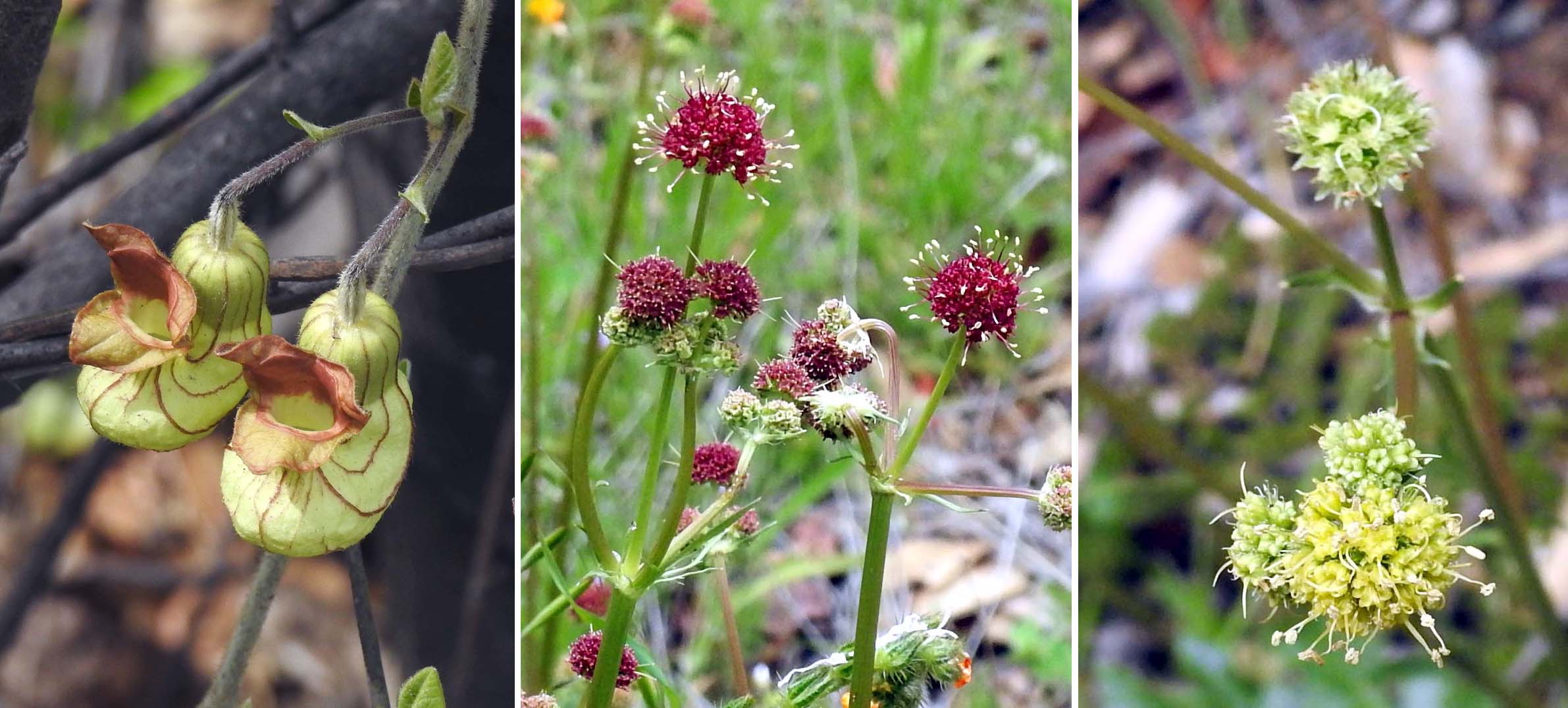
Dutchman's Pipes - Purple Sanicle - Poison Sanicle
Aristolochia californica - Sanicula bipinnaifida - Sanicula bipinnata

I couldn't agree more with Hank Meals' wish to travel back in time to witness this beautifulWeda ceremony!  It must have been amazingly beautiful!

The above wildflowers were photographed at the South Yuba River State Park 
just this past week!  Get out there if you can and immerse yourself in 
the beauty of thousands of spring wildflowers!

Northern Flicker (male) - Steller's Jay
 Colaptes auratus - Cyanocitta stelleri

More Snow & Rain!

This past week has been snowy and rainy!  On Monday morning we woke up to 3" of wet snow on the ground.  On Thursday and Friday it rained a total of  aproximately 1.5"!  The total precipitation for the week was a little over 2", bringing us to a water-year total of approximately 31"!  I hope March continues to bring lots more wet weather!

 At this time of year the snow melts quickly.  Monday morning I went walking in a blizzard, and every tree was blanketed in snow!  By the afternoon, the trees were totally snow free, and there was an inch or two of patchy snow left on the ground!  I'm grateful for the warmer, longer days and I think the birds are as well!

Northern Flicker (female) - Colaptes auratus 

I haven't discussed our amazing year-round avian residents for a while.  Often overlooked because they are commonly seen, these birds should be applauded for their resourcefulness and hardiness through winter!  

There have been a few Northern Flickers in our neighborhood all winter this year. This is probably due to the general lack of snow on the ground. Unlike other woodpeckers, flickers usually forage on the ground for ants, beetles, moths, snails, flies, larvae, seed and berries! When there is a lot of snow, they migrate to lower snow-free elevations. Measuring 12.5" in length, they are the second largest woodpecker in North America (the Pileated Woodpecker being the largest). They are sexually dimorphic in appearance. The most obvious difference is the bright red "malar" on the male's head, which is absent in the female. More Northern Flickers should be arriving for the breeding season soon!

Steller's Jay - Cyanocitta stelleri

There are about 16 Steller's Jays that live here year-round. Every morning they really squawk to each other. Sometimes they sound quite alarmed! They are very inquisitive, and are usually the first to notice anything new in the area. They eat just about anything including seeds, insects, fruit, garbage, carrion, pet food, and small mammals! Lately I've been watching them fly by with Live Oak acorns in their beaks! Yesterday, I heard what I thought was a woodpecker hammering on a tree trunk. It turned out to be a Steller's Jay pecking on an acorn, that he was holding against the top of a branch!
Common Ravens - Corvus corax

We have two Ravens that live in our canyon year-round. I watch them fly by daily as they head down to the highway, from their distant up-canyon roosting area. The highway is a good source of food for these ravens, as roadkill provides carrion. Ravens have a diverse diet that includes arthropods (even scorpions), amphibians, reptiles, birds (adults, chicks, and eggs), fish, small mammals, carrion, grains, buds, and berries. Invertebrates consumed include Orthoptera, Lepidoptera, Coleoptera, craneflies, ants, slugs, scorpions, earthworms, snails and diversity of marine invertebrates. There isn't any research available that states that Ravens mate for life.  However, family members usually stick together for years. 

Other year-round residents are the Spotted Towhee, Black Phoebe, Song Sparrow, Great Blue Heron, Belted Kingfisher, American Dipper, Canada Goose, Sharp-shinned Hawk, Cooper's Hawk, Northern Goshawk, and sometimes the Common Merganser!

                                                Spring Rain - ©Kok 2015

More Damp Earth Art!

 Since we still need more rain, I am continuing to maintain this blog and am again sending out yet another "Call for Art" in celebration of rain. My intention is to focus on the need for rain, and through collective positive energy invoke rain to fall. It is just a wish, a thought, and a hope. If you would like to submit some art, or writing, or a photo please email me at northyubanaturalist@gmail.com. Check out what's already been submitted at dampearthart.blogspot.com

You can view what was submitted last year at dampearth.blogspot.com.
I will be posting new art weekly. Check it out and pray for rain.


Are anymore plants blooming?

What's happening in the Lakes Basin?

What kind of insects are out and about?


Check back next week for the answers to these questions and more!

Unfortunately you can no longer sign up to get my blog emailed to you.
Something changed at Blogspot.com. Oh well... However, my blog looks better if you just go to northyubanaturalist.blogspot.com, rather than get the emailed version. I suggest that you just bookmark my blog and visit it every Sunday afternoon!

Your questions and comments are greatly appreciated! Please feel free to email me at northyubanaturalist@gmail.com. Thanks!