Thursday, December 15, 2022

To Feed or Not to Feed

 
Steller's Jay - Cyanocitta stelleri

We recently got an inch of snow and LOTS of rain in our neighborhood.  At the higher elevations it snowed and didn't rain, resulting in several feet of new snow on the ground!  Seeing birds in the snow is beautiful, but it also makes me worry about their survival. 

In May we got several inches of snow and cold temperatures that kept the flowering fruit trees from being pollinated. The only non-native fruits that weren't affected were the ones that weren't blooming at the time, mainly blackberries and grapes.  Hardly any of the apples, cherries, pears, plums, or persimmons bore fruit this year.  As a result, this fall there was a lot less food available for the wildlife in our neighborhood. 

What about the native trees, shrubs, and wildflowers. Were they in bloom in May when the snow fell?  Did their "crop" fail as well? Did they produce a lot less seeds and fruits?  The Black Oaks were definitely affected and didn't produce any acorns this year!  I'm guessing that most of the native plants experienced "crop failure", and that there is indeed a current shortage of these native, wild foods. This shortage could well be affecting seed-eating bird and rodent populations, and in turn rodent-eating mammal and raptor populations.  It is surprising how much an unseasonally late snow can affect so much, for months and months!
  
Steller's Jays - Cyanocitta stelleri

Because of these apparent food shortages, I have decided to occasionally feed our local birds this winter.  However, feeding birds can cause problems for birds.  Bird feeders can concentrate birds in one area, bring birds together that are not usually together, spread disease, and create waste. 

 To keep that from happening I am NOT using bird feeders, but am casting bird seed on the ground. I have two separate areas where I'm casting the seed. I am also changing the areas where I cast the bird seed on a weekly basis. I am not feeding the birds on sunny, warm days when they should be able to find food, but rather limiting my feeding to days when snow is covering the ground and temperatures are low. I am astounded at the number of birds that show up!  Recently, I counted 24 Steller's Jays eating the seed I had scattered!  I hope I'm helping, but I don't know that for sure,  For now, I think limited help is the best idea. Perhaps no help would be even better.

I am concerned with the number of websites that encourage feeding birds, especially in the winter.  Most of them don't mention the problems associated with bird feeders.  Please do your own research before you decide to feed any wild birds.  I would highly recommend  the following articles as a starting point;  https://www.audubon.org/news/to-feed-or-not-feed and https://www.fws.gov/story/feed-or-not-feed-wild-birds and https://thelocalreporter.press/to-feed-or-not-to-feed-is-that-the-question/.

Black Phoebe - Sayornis nigricans

What do songbirds eat in the wild?

During the spring and summer months, most songbirds eat mainly insects and spiders. Insects are easy to find and catch, and are very nutritious. During fall and winter, however, birds that don’t migrate must eat fruits and seeds to survive.  

There is one male Black Phoebes that is a year-round resident in our neighborhood.  Its diet consists mainly of a variety of insects, including dragonflies, damselflies, spiders, bees, wasps, beetles, and sometimes small berries. Maybe it's eating the dried-up blackberries. How do they survive here in the winter when these insects aren't out and about? I often see it perched above the river. Perhaps some aquatic insects hatch now?  

Spotted Towhee - Pipilo maculatis

During the breeding season Spotted Towhees feed on a variety of beetles, as well as a wide range of plant seeds and fruits. In the winter their diet is reduced to seeds and fruits. These birds live year-round in our neighborhood.  They use the hop-back-scratch method on the ground to uncover their foods. 

Mountain Quail - Oreortyx pictus

Mountain Quail are another of our year-round residents.  The primarily feed on nuts, seeds, leaves of plants, but will also eat insects, especially from galls!

Northern Flicker - Colaptes auratus
 
Another year-round resident is the Northern Flicker.  In the summer it primarily eats ants and beetles.  In the fall and winter it consumes fruits.

European Starlings and Mistletoe with berries
Sturnus vulgaris - Phoradendron leucarpum

When I state that birds eat "fruits", I don't just mean the domestic non-native fruits such as apples and cherries.  I mean the native "fruits" that contain the seeds of a plant, such as a rosehips and mistletoe berries. 

One of the most available fruits at this time of year is mistletoe. I took the above picture at Gray Lodge two weeks ago, but we also have this mistletoe in our neighborhood. Over 28 species of birds in California eat the berries, as well as gray squirrels, raccoons, pine martens, chipmunks, porcupines, and ringtails! Sheesh! Mistletoe plants are dioecious, with the male and female species being separate plants. The female plants are the ones that produce berries! Apparently mistletoe berries are so popular that some mammals and birds, including Bluebirds, actually spend the night in them! They may do this to establish "ownership" of the berries, or for the warmth of the dense clumps, no one knows for sure! If you squish a mistletoe berry between your fingers, it will stick to your finger and you can't shake it off! They have a thick, viscous substance that makes them sticky. Being sticky, the seeds are easily transported to new areas by birds and mammals.

Grizzly Peak - 12/`12/22

Damp Earth Art

We got an inch of snow on Sunday morning, after 24 hours of pouring rain! Sierra City and the Lakes Basin got 3+ feet of snow!  The total rainfall in our neighborhood for Saturday and Sunday was 3.95"!!!  This brings us to a water year total of 16.07". The river flow peaked at 1500 CFS early Saturday morning, and rose 2.5 ft in height!  Since then it's been sunny and cold, with lows in the 20's overnight. Possible rain is predicted for the beginning of next week!  Fingers crossed!

I'm going to keep posting rain inspired writings, art, etc. on my blog at dampearthart.blogspot.com. Any submissions would be greatly appreciated. Please join me in my continuing hope for precipitation! Perhaps our collective efforts may help it happen.

Is the Fall color all gone?

What's going on in the foothills?

Check back next week for the answers to these questions and more!

Unfortunately, you can no longer sign up to get my blog via email. Just go to northyubanaturalist.blogspot.com directly.

Your questions and comments are greatly appreciated. Please feel free to email me at northyubanaturalist@gmail.com. Thanks!

Saturday, December 10, 2022

Winter Weather

No Yuba River - 12/8/22

Luckily it's been rainy and cold this week, and more is expected in the near future!  Our total precipitation for the past week is 5.75", for a water year total (since Oct. 1) of 12.12".  The river rose 2 feet, and went up to 800 CFS (Cubic Feet per Second) last Sunday!  It has since dropped 2 feet and decreased to 200 CFS.  More weather is in the forecast for today, tomorrow, and the week ahead!  In fact it's pouring right now, on Saturday morning!  Yahoo!  I hope the storms keep coming and wash this drought away.  Fingers crossed!  

American Kestrel (male) - Red-tailed Hawk (adult)
Falco sparveriusButeo jamaicensis

North Yuba River News

New this week, the Common Goldeneyes have arrived, as well as an American Kestrel!!!  The Red-tailed Hawk is still hunting on the river corridor, some of the Common Mergansers are still here, and our year-round river residents are doing just fine!
_____________

I was so surprised to see an American Kestrel in our neighborhood this week! In the past there has been a kestrel perching in the Open Slope, but the earliest I've seen one there is in January! I have no idea if this is the same one, or if it will be sticking around. I walked down to the Open Slope right after I saw it, but it wasn't there. I'll keep checking.

American Kelstrels are the smallest falcon in North America, measuring 9" in length, with a wingspan of 22", and a weight of 4.1oz. Their diet consists primarily of insects and small rodents such as: grasshoppers, beetles, dragonflies, scorpions, spiders, butterflies, moths, voles, mice, shrews, bats, snakes, lizards, frogs, and small songbirds! Right now there aren't many insects around, so it was probably hunting for rodents in the field.
_____________

We've seen the Red-tailed Hawk several times along the river corridor this week.  It must be finding enough to eat!  Red-tails are medium sized hawks, measuring 19" in length, with a wingspan of 49", and a weight of 2.4 lb. They are one of the most commonly seen raptors in North America, and are found from coast to coast in the U.S. and as far south as Venezuela. If the winter is snow-free, they will live year-round in our neighborhood. They like to perch in trees, or posts on the edges of clearings or meadows, and watch for prey. Ground squirrels, gophers, rabbits, mice, snakes, lizards, kestrels, and meadowlarks are their main prey. They use the perch-and-wait method of hunting. Once prey is sighted they will drop from their perch, flap-and-glide downward, thrust their legs forward when about 3 m from prey, and grab prey with their feet.

Common Goldeneyes (female - males) - Bucephala clangula

Just this week the Common Goldeneye ducks arrived on the river! I've been expecting them! They always arrive around the 2nd or 3rd week in December, and spend the winter here. 

In California, Common Goldeneyes are the only ducks that regularly spend the winter on rivers and lakes above the foothills of the western Sierra. They are diving ducks and eat fish, aquatic vertebrates, seeds, and tubers. When diving, they keep their wings pressed to their sides underwater, and swim with their webbed feet! They are amazing to watch when they're underwater! This species can fly up to 40 mph, and the wind "whistles" through their wing feathers!

Right now the males are in their black and white mating colors, and the females have a yellow tip to their bill. Pair formation is just starting! They will migrate to their northern breeding grounds in the boreal forests of northern Canada and Alaska in the Spring. I am so thrilled that they have once again returned to our neighborhood for the winter!

Common Mergansers (females) - Mergus merganser

I saw a few of the Common Mergansers earlier this week. They will probably migrate down to the foothills and central valley as the winter weather continues.

Great Blue Heron - Ardea herodias 

The lone Great Blue Heron that I see year-round along our section of the river, is usually perched in a tree or in the river itself. 


Wednesday was sunny, so my friends Nancy, Diane, Bev and I went for a hike down in the foothills, at the South Yuba River State Park. It was a beautiful day with big puffy clouds in a brilliant blue sky. The park is a beautiful oak woodlands with the South Yuba River on one side and the combined forks of the North and Middle Yuba Rivers on the other.  It is at a much lower elevation (567') than where I live (2,674').  It is one of my favorite places to go in the winter,  because it is snow-free, populated with birds, and quite a bit warmer than my neighborhood!


We hiked  the loop trail to Point Defiance, and then we hiked along an old road to the upper arm of Englebright Lake, where the combined North and Middle Forks of the Yuba River merge with the lake. It was a little wintery but not cold, and some green grass was popping up in the dry grasses from the recent rains!

Pacific Madrone - Arbutus menziesii

This year the Madrone Trees were LOADED with berries! Many mammal and bird species feed off the berries, including American Robins, Cedar Waxwings, Band-tailed Pigeons, Varied Thrushes, Quail, Mule Deer, Raccoons, Ring-tailed Cats, and Black Bears. These trees can grow up to 130' in height and 3' in daimeter.  They can also live for 400 to 500 years!

Band-tailed Pigeons - Columba fasciata

We saw several large flocks of Band-tailed Pigeons 
feasting on the Madrone Berries!

Toyon Berries - Heteromeles arbutifolia 

As we drove down to the park, we drove past 100's of Toyon bushes loaded with berries! Toyon berries form in June or July, but don't ripen until December. When they are green they contain cyano-glucosides in their pulp. When a bird tries to eat a green berry, cyanide gas is released and deters the bird! The unripened berries are also full of bitter tannins that discourage foragers! Over time the cyanide compounds gradually move into the seeds and the tannins diminish. In December, when the berries are bright red, they aren't bitter and the pulp no longer contains cyanide compounds! Approximately 20+ species of birds eat Toyon berries during winter including Western Bluebirds, Band-tailed Pigeons, Cedar Waxwings, Hermit Thrushes, and Varied Thrushes. Foxes, Brush Rabbits, Black Bears, and Coyotes also feed on the ripened berries!

Black Bear scat containing berries

We came across this Black Bear scat full of Toyon berries, on the trail!  It certainly looked like they had eaten LOTS of them!

Willows along Englebright Lake showing the last of the fall color

When we got back to our car, the last of the afternoon light was on the river-edge willows. Such beauty!  Hopefully, we'll revisit this park in the near future, and walk along the Buttermilk Bar Trail with its stunning views of the South Yuba River.


Damp Earth Art

Winter storms have brought almost 6" of rain to our neighborhood this week, what a miracle!  Hopefully more storms are coming our way!

I'm going to keep posting rain inspired writings, art, etc. on my blog at dampearthart.blogspot.com. Any submissions would be greatly appreciated. Please join me in my continuing hope for precipitation! Perhaps our collective efforts may help it happen.
What's happening on the river?

Is the Fall color all gone?

How are the year-round avian residents doing?

Check back next week for the answers to these questions and more!

Unfortunately, you can no longer sign up to get my blog via email. Just go to northyubanaturalist.blogspot.com directly.

Your questions and comments are greatly appreciated. Please feel free to email me at northyubanaturalist@gmail.com. Thanks!

Saturday, December 3, 2022

Gray Lodge Wildlife Area

The Sutter Buttes from the Gray Lodge Wildlife Area

Last Tuesday, my husband and I drove down to the Gray Lodge Wildlife Area, near Gridley, CA.  We do this every winter, often more than once!  I am in love with Gray Lodge and its wild inhabitants!  This year we saw some birds that we'd never seen before, as well as some mammals!  It was a clear, blue-sky day, filled with the sounds and sights of migrating Snow Geese!  There were thousands of them!  Such incredible beauty!

Gray Lodge is run by the California Department of Fish and Wildlife. I have written about it in depth in several past blogs. Just enter "Gray Lodge Wildlife Area" in the "search this blog" bar on the top right of this page, to find more information.

Snow Geese - Anser caerulescens

Snow Geese roost in Gray Lodge by the thousands! Their constant loud calls permeate the wetland, and are as much a part of our experience as the physical presence of the birds. They roost on water and forage in the local fields for grains and marsh plants. Most feeding is done from early morning to late evening. They will begin their 5,000 mile migration to the arctic in February, arriving in their breeding grounds in mid to late May. If you haven't visited Gray Lodge yet this winter, now is the time to go!

Snow Geese - Anser caerulescens

Gadwall (male & female) - Mareca strepera

There are a LOT of dabbling ducks at Gray Lodge in an array of colors.  Most of the males are in their breeding plumages now and are pairing up!  They will not breed until Springtime, when they migrate north to their breeding grounds.  The most prevalent ducks were the Gadwalls, Pintails, and Northern Shovelers.

Northern Pintail (males & females) - Anas acuta

In general, most female dabbling ducks are drabber and more camouflaged than the males.  Camouflage works to the females advantage as they do most of the brooding of the eggs and the raising of the young.
  
Northern Shoveler (male & female) - Spatula clypeata

Male ducks moult their beautiful mating plumage, and change to dull, female-like plumage for a month or more in summer after breeding. This is called the "eclipse" phase.

Cinnamon Teal (female & male) - Spatula cyanoptera

The male Cinnamon Teal is so brilliant in its rusty-read mating colors!  Even its eyes are red! The transition from the eclipse phase back to their mating colors begins in the fall and ends in early winter.

Pied-billed Grebe (adult)  - Black-necked Stilt (adult)
Podilymbus podiceps - Himantopus mexicanus

There are also grebes, shorebirds, wading birds, raptors, and songbirds at Gray Lodge!  I saw one pied-billed ("pied"means "having two or more colors") grebe, and lots of Black-necked Stilts with their bright red legs.

Red-tailed Hawk - Turkey Vulture 
Buteo jamaicensis - Cathartes aura

Red-tailed Hawks and Turkey Vultures were the raptors that we saw this time at Gray Lodge.  They were quite common throughout the refuge!  

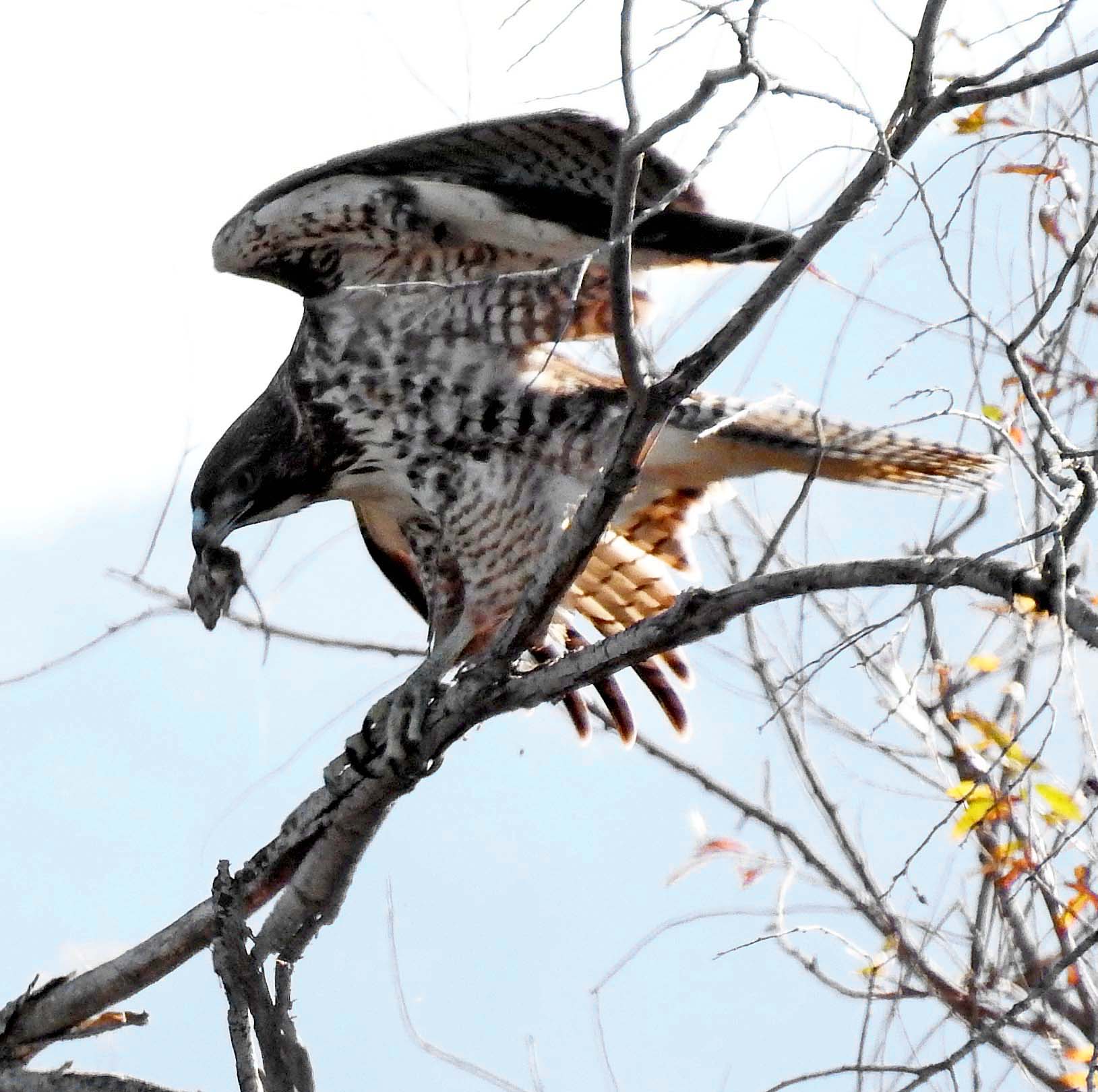
Red-tailed Hawk - Buteo jamaicensis

I saw this Red-tailed Hawk softly swoop down to the road, land, and then fly off with a mouse in its beak!  It landed in a nearby bare tree and squeezed the mouse with its foot to kill it!  It then swallowed it whole! The whole process took less than a minute! WOW!!!

Green Heron (adult) - Butorides virescens

We were in a wooded tangle on one of the wetland trails, when a biggish, loudly squawking, dark bird landed in one of the nearby trees!  It only stayed for a few seconds and then took off squawking and flew out of sight!  I recognized it  immediately as a Green Heron!!!  WOW!  It was too quick for me to grab a photo, but fortunately I have some photos from 2019 when I last saw one of these unusual birds at Gray Lodge!

Green Heron (adult) - Butorides virescens

These uncommon, small herons are seen along secluded marshes, lakes, ponds and slow-moving streams, that are shaded by riparian trees. They are only 18" in length, and have short legs. They eat small fish, crustaceans, insects, frogs, and rarely small mammals. They hunt for prey day and night! They wade into shallow water and wait patiently for prey to pass by. They will also dive for prey from a perch, head first, and become totally submerged!!!  I find them to be strikingly feathered and gorgeous!

Orange-crowned Warbler (adult) - Nuttall's Woodpecker (female)
Leiothlypis celata - Dryobates nuttallii

I have never seen either of these two birds before!  The Orange-crowned Warbler was looking for insects to eat on the plants bordering a canal. Although most of these warblers spend the winter in Mexico, some overwinter in California's Central Valley.  In California, they breed primarily in the oak woodlands of the foothills, where they are quite common. The name comes from an orange patch of feathers on top of the male's head, that is rarely observed. 

This Nuttall's Woodpecker was pecking at the surface of the bark on a Cottonwood tree, looking for insects to eat.  Unlike other woodpeckers, it doesn't drill into the tree trunk to get beetle larvae.  It will also eat fruit and berries in winter, including poison oak berries!  After a few seconds,  it flew off making a loud rattling call just like a Kingfisher! This species spends it's entire life in California, mainly in the oak woodlands, and isn't found anywhere else in the world!  They aren't that commonly seen in their habitat!  How lucky to see and hear one of them!

Mule Deer (doe) - Audubon's Cottontail
Odocoileus hemionus -  Sylvilagus audubonii

Unbelievably, we saw three different mammals this time!  I saw a deer peacefully eating forbes near one of the canals!  That was a surprise, and we also spotted a Cottontail along the trail!  This was only the second time I've seen these two mammals at Gray Lodge, in all the times I've been there!

River Otter (adult) - Lontra canadensis

To my complete surprise, a River Otter was swimming towards us down one of the canals!  When it saw me, it turned left, climbed up over a dirt dike, and swam off into a pond on the other side of the dike!  

River Otter (adult) - Lontra canadensis

Once again, iike most of my wildlife sightings, it all happened in a few seconds, and I only got a few photos! Doesn't it's soaking-wet, thick fur look amazing?

The Sierra Buttes from Blue Point

3 hikes, 21 miles, and
3 different views of the Sierra Buttes!

We went on three different hikes this past week, in anticipation of snow closing the trails. The Buttes Road, Love's Falls, and the Halls Ranch/Fiddle Creek Ridge Trail added up to a total of 21 miles of hiking!  Each trail had a different view of the Sierra Buttes! 


There are many roads on the southwest facing side of the Sierra Buttes, mainly dating from the gold mining days.  My friends Nancy and BJ, and I, hiked on one that had lovely views of the Sierra Buttes, the North Yuba River canyon, and even the Coast Range!  This road starts just before the dump above "downtown" Sierra City. The round trip hike was a little over 6 miles.


The snow was minimal, the sun was warm, and the air was clear! 
We ended up at Blue Point, around 6,500' in elevation where we lingered in the sun and 8" of velvety snow, before we headed back home!

The Sierra Buttes from the Love's Falls/Haypress Creek Trail

Lat Monday my husband and I decided to hike the Love's Falls/Haypress Creek Trail to check out the fall colors.  To our delight the  Black Oaks were gorgeous in their lingering fall colors and the view of the Sierra Buttes was stunning! This trail is just past Sierra City off of Highway 49.  We went about half way, for a round trip distance of approximately 4 miles.


This hike was around 5,000' in elevation, and there wasn't any snow on the trail.  There was snow on the north facing slope across the Haypress Creek drainage, but we didn't go that far.  


It was another beautiful, warm, clear, blue-sky day, highlighted by the glowing yellows, oranges, and browns of the Black Oak Trees.

The Sierra Buttes from the Halls Ranch/Fiddle Creek Ridge Trail

Last Sunday, my friend Diane and I hiked the Halls Ranch/Fiddle Creek Ridge Trail, for a total of 9.38 miles!  This trail starts out around 2,400' in elevation, and climbs up to about 4,500' in elevation!  There is a beautiful view of the distant Sierra Buttes where the trail first reaches the ridgetop. This trail starts about 5 miles west of Downieville, off of Highway 49.


The first two+ miles of the trail climb UP to the ridgetop. From there the trail follows the ridge uphill and downhill for about 7 miles through oak woodlands and conifer forests.  It also alternately travels from the sunlit side of the ridge to the shadowed side of the ridge, as it weaves its way downhill. 


About every 20 minutes or so, the trail would open out to beautiful, expansive views of the North Yuba River Canyon.  I loved the contrast between the warm oranges and browns of the late season Black Oak leaves, and the blue shadowed, north facing, forested slopes across the river canyon!


At some points of the trail we could look down on Highway 49 alongside the shining North Yuba River!


This was our last hike before the recent storms, and it was filled from start to finish with the fall color of thousands of Black Oaks!  Such beauty!

Recent snow on the ridge above our neighborhood

Damp Earth Art

Some storms came in this week and dropped a few inches of snow at the higher elevations!  We got mostly rain in our neighborhood, and more is on the way for the next three days!  Yahoo!  I hope the storms keep coming and coming! 

I'm going to keep posting rain inspired writings, art, etc. on my blog at dampearthart.blogspot.com. Any submissions would be greatly appreciated. Please join me in my continuing hope for precipitation! Perhaps our collective efforts may help it happen.


What's happening on the river?

What's happening in the foothills?

Check back next week for the answers to these questions and more!

Unfortunately, you can no longer sign up to get my blog via email. Just go to northyubanaturalist.blogspot.com directly.

Your questions and comments are greatly appreciated. Please feel free to email me at northyubanaturalist@gmail.com. Thanks!