Saturday, May 22, 2021

Cloudy, rainy weather at last!

North Yuba River - 5/20/21

"A rainy day is the perfect time
for a walk in the woods."
                                    Rachelle Carson

We are in the middle of a three-day forecast for scattered showers and thunderstorms!  On Thursday, and Friday we only got a total .02" of rain, but there were a few heavenly downpours and it was damp, moist, fragrant, and wonderful!  To me the fragrance is nature's camphor, but "petrichor" is the official name.  Petrichor was coined by Australian scientists in 1964 to describe the unique, earthy smell associated with rain. It is caused by the water from the rain, along with certain compounds like ozone, geosmin, and plant oils. One of my favorite authors, Brian Doyle, describes it perfectly in the following passage from his book Mink River.

“Rained gently last night, just enough to wash the town clean, and then today a clean crisp fat spring day, the air redolent, the kind of green minty succulent air you'd bottle if you could and snort greedily on bleak, wet January evenings when the streetlights hzzzt on at four in the afternoon and all existence seems hopeless and sad.”

North Yuba River - 5/20/21

The river is up, from the rain and snowmelt, but still slow at only 358 cfs.  However, any moisture is welcome!  Rain, rain come on down!

Harvest Brodiaea - Brodiaea elegans

Blooming Wildflowers!

Along the lower elevations of the North Yuba River corridor, there are lots of flowers in bloom!  Although the carpets of Sky Lupine have mainly dried up, there are still many lovely flowers to discover.  I headed out in the rain to see what I could find, and had a great time exploring!  The Harvest Brodiaea pictured above is so elegant and strikingly colored!  Their deep rosy-purple color contrasts beautifully against the dry grasses.  They are one of the last Brodiaeas to bloom.  The raindrops made them even more beautiful! 
 
Showy Phlox - Tongue/Diamond Clarkia
Phlox speciosa - Clarkia rhomboidea

To my delight I found a wildflower I'd never seen before, Showy Phlox!!!  I've seen lots and lots of Spreading Phlox (Phlox diffusa) in the Lakes Basin, but never this foothill variety!  Unlike Spreading Phlox, this does not have a heavy scent.  However, on a warmer day it might.  I lucked out and saw it during a downpour!  The plant is multi-branched, about 16" tall, and covered with clusters of pink and white blossoms.  The chewed petals indicate it's a favorite meal for some insects!

Tongue/Diamond Clarkia is one of my favorites.  It's not that common or profuse, but it can be found if you take the time to look.  The flowers are small, about 3/4", but finely patterned and colored.  The name rhomboidea refers to the diamond-shaped part of the petals.

Indian Rhubarb - Roundtooth Ookow
Darmera peltata - Dichelostemma multiflorum

Along the edge of the river are the large stalks of the blooming Indian Rhubarb.  They can reach from 1'-5' in height!  The clusters of pink flowers usually appear before the large leaves, that can be 2' wide. It grows from thick, wide rhizomes, or continuously growing horizontal underground stems which put out lateral shoots and adventitious roots at intervals. The ginger that you can buy in stores is a rhizome.

The Roundtooth Ookow is in the Brodiaea Family which is has three main genera; Brodiaea, Dichelostemma, and Tritelia.  They grow from starchy corms, or
rounded underground storage organs consisting of a swollen stem base covered with scale leaves.  The Native Americans called it "Ookow" and the corms were an important starchy food source for them.

Purple Milkweed - False Solomon's Seal/Feathery False Lily of the Valley
Asclepias cordifolia - Maianthemum racemosa

Purple Milkweed is one of the local native Milkweeds, that can be seen growing along the highway.  It's a super important plant for the Monarch Butterfly. It begins in the Spring, when female Monarch Butterflies lay 100's of eggs on the underside of Milkweed leaves. Four days later the caterpillars hatch out of their eggs! These newly hatched caterpillars will eat only Milkweed leaves for the next 2 weeks. Then each caterpillar will form a chrysalis and pupate. After 10 days a new adult butterfly will emerge from each chrysalis, and start the whole process again. This process will happen four more times in the Summer. As adults, they feed on nectar from a variety of wildflowers.

To my surprise I discovered that a plant that I had always called "False Solomon's Seal", is now officially called "Feathery False Lily of the Valley", according to calflora.org!  I like the new name better.  The older name apparently came from its thick, fleshy, white, irregularly-shaped rhizomes that bear rounded scars where the previous year's stems arose.  Supposedly it is the resemblance of these scars to the two inverted triangles that were the symbol or seal of King Solomon that gave rise to the old common name.  How odd is that?!!

Kit-kit-dizze/Mountain Misery - Interior Rose
Chamaebatia foliolosa - Rosa woodsii var. ultramontana

Kit-kit-dizee/Mountain Misery has a strong, oily, and to me, nauseous odor.  Kit-kit-dizze is the Native American name. They used it as an herbal remedy for colds, coughs, rheumatism, chicken pox, measles, smallpox and other diseases.  Mountain Misery is the European name, and refers to its strong-scented repellent sap that would stick to clothing.  It is in the Rose Family of plants.

There are lots of domestic "wild" roses growing in our area, but they are not native. The native Interior Rose is a much smaller shrub, but the fragrance of the roses is heavenly!  If you find one of these little roses, make sure to inhale its fragrance!

Canyon Dudleya - Heermann's Golden Sunburst
Dudleya cymosa - Pseudobahia hermannii

On the hot and dry slopes you can find the succulent Canyon Dudleya growing.
  These flowering plants demonstrate adaptations to a hot and dry environment, with thick succulent leaves, a thick waxy cuticle and a unique metabolism.  During the day the stomata close to conserve water.  During the night the stomata open, allowing CO2 to enter and be fixed as organic acids.

Heerman's Golden Sunburst is also now blooming in the hot, dry, areas along the highway.  It is one of the many wildflowers in the Sunflower Family that grow locally.

Sticky Monkeyflower - Diplacus  aurantiacus

Blooming Shrubs!

Sticky Monkeyflower bushes are in profuse bloom along the highway between Indian Valley and Downieville!  There are thousands of them, each with hundreds of flowers! It's just gorgeous!   

Western Chokecherry - Deerbrush - Mock Orange
Prunus virginiana var. demissa - Ceanothus integerrimus - Philadelphus lewisii

These lovely blooming shrubs are fairly common, with Deerbrush being the most prevalent.  My favorite is the Mock Orange which has a light, sweet fragrance.

Pale Swallowtail - Papilio eurymedon

Butterflies!

There are a wide variety of Butterflies in the area right now.  I keep seeing ones I've never seen before!  Here are some interesting "Butterfly Facts" from butterflyconservatory.org

"Butterflies have "complete" life cycles, with four different stages: egg, caterpillar (larva), chrysalis (pupa), and adult. The entire life cycle, from the deposition of the egg to the emergence of the adult, usually takes about a month for most butterflies. Each species of butterfly has a different adult life span. Some adult butterflies only live for a few days, while others live for a few weeks or even several months (if they experience dormant periods of diapause or hibernation). The average lifespan for most adults is one to two weeks.

Chalcedon Checkerspot - Euphydryas chalcedona

Butterflies have compound eyes and simple eyes. They see very differently from us; they can see ultraviolet rays (which are invisible to us).

Clodius parnassian - Parnassius clodius sol

A butterfly's antennae, palps, legs and many other parts of the body are studded with sense receptors that are used to smell. The sense of smell is used for finding food (usually flower nectar), and for finding mates (the female smelling the male's pheromones)."

Common Buckeye - Junonia coeria


"Butterflies are less efficient than bees at moving pollen between plants. Highly perched on their long thin legs, they do not pick up much pollen on their bodies and lack specialized structures for collecting it. Butterflies probe for nectar, their flight fuel, and typically favor the flat, clustered flowers that provide a landing pad and abundant rewards. Butterflies have good vision but a weak sense of smell. Unlike bees, butterflies can see red."

Common Checkered Skipper - Pyrgus communis

Skippers are not true butterflies. They have hooked antennae, a moth-like body, and their wings are held at a different angle than true butterflies. Like true butterflies, skippers have scales on their wings, a coiled sucking mouth part, and a complete metamorphosis.

Tamarack Lake - 5/14/21

It's not quite Spring in the Lakes Basin!

Last week we headed up to the Lakes Basin, even though the forecast was for lightning and scattered thundershowers.  Not much rain fell, but just enough to make everything damp and heavenly scented!  We decided to stay fairly low in elevation, to avoid any lightning strikes, so we headed up to a favorite lake of ours.  The ground was snow free, but the water was too high to cross a creek, so we hiked up to Tamarack Lake instead.  It was still definitely winter up there, with the alders and willows still bare, and patches of snow still abundant!

Western Spring Beauty in the Rain - Claytonia lanceolata

We did see a few flowers blooming along the trail.  There were lots and lots of Spring Beauties, which you have to look at closely to appreciate!  They are one of the very first flowers to bloom in the Spring.
 
Western Spring Beauty (close-up) - Fawn Lily
Claytonia lanceolata - Erythronium purpurascens

We also saw our first Fawn Lilies of the year and a few Mountain Violets.  They were even more beautiful with the raindrops on them!
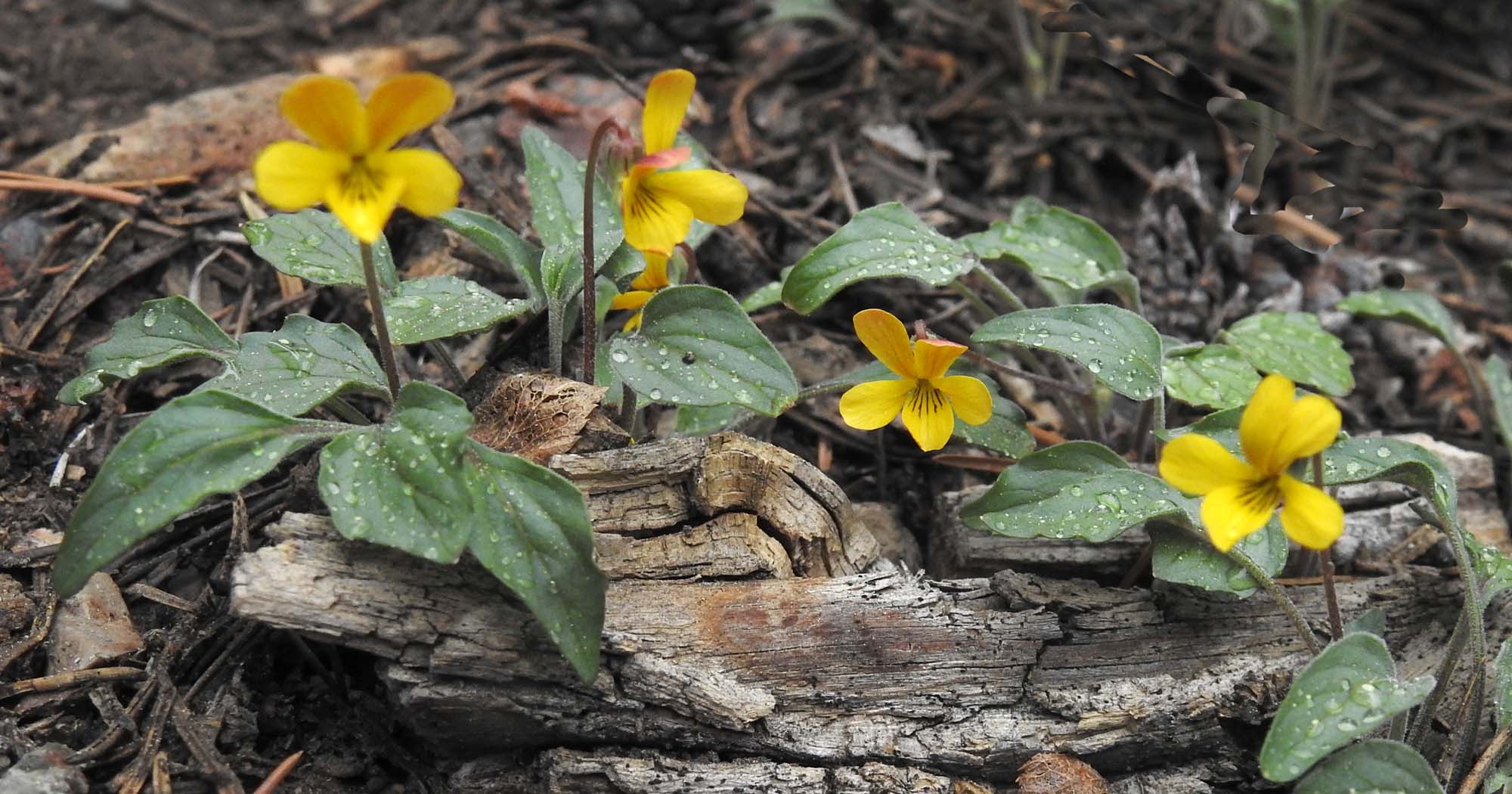
Mountain Violet in the Rain - Viola purpurea

These violets can be distinguished by the shape of their leaves, as well as the purple color on the underside of the leaves and the top two petals.

Lakes Basin Blizzard - 5/21/21

Just this past Friday we went back to the Lakes Basin for a hike.  The forecast was once again for a chance of scattered showers and thunderstorms.  As we drove up the Gold Lake Road, it started to snow and we were quickly engulfed in a blizzard!!!  Needless to say, we didn't stick around and headed home in the rain and snow.  We're so lucky to be getting all this moisture!  I hope the storms keep coming!

Corn Lilies after the Rain

More Damp Earth Art!

We just had a few days of light rain!  However, since we are indeed in a drought year, I am once again sending out a "Call for Art" in celebration of rain. My intention is to focus on the need for rain, and through collective positive energy invoke rain to fall. It is just a wish, a thought, and a hope. If you would like to submit some art, or writing, or a photo please email me at northyubanaturalist@gmail.com. Check out what's already been submitted at dampearthart.blogspot.com

You can view what was submitted last year at dampearth.blogspot.com.
I will be posting new art weekly. Check it out and pray for rain!


What's happening on the North Yuba River? 
What are these insects?

Where are the Bears?

What's happening in Sierra Valley?

Check back next week for the answers to these questions and more!

Unfortunately you can no longer sign up to get my blog emailed to you.
Something changed at Blogspot.com. Oh well... However, my blog looks better if you just go to northyubanaturalist.blogspot.com, rather than get the emailed version. I suggest that you just bookmark my blog and visit it every Sunday afternoon!

Your questions and comments are greatly appreciated! Please feel free to email me at northyubanaturalist@gmail.com. Thanks!

Friday, May 14, 2021

Morels!

Morel - Morchella esculenta

After we got a half an inch of rain a few weeks ago, some Morel mushrooms popped up on our property! Mushrooms aren't flowers, but they are the fruiting body (spore producing organ) of a fungus. Morels are unique mushrooms, in that they appear in the spring rather than the fall. They are a type of sac fungi that aren't that common! Sac fungi get their names from the fact that they produce their spores, called ascospores, in special pods or sac-like structures called asci. In other words, the spores are found on the walls of the honey-combed exterior.

They are quite difficult to see as they are SO camouflaged with their surroundings. At first I only saw two of them, but as I carefully searched the area I saw a total of 13 mushrooms. It was a fun "treasure hunt"! I didn't pick any of them. I left them there to release their spores and reproduce. Many wild critters eat mushrooms, including deer and flying squirrels!  

Morel - Morchella esculenta

They all look alike, but each one is unique.  They were about 3"- 4" tall.  Aren't they cool looking?

Oleander Aphids - Aphis nerii

What about those Bugs?

Okay, for a while now I've been promising to talk about the bugs I've been seeing.  So I've finally done some research and here's what I've learned!  The subject of "bugs" is complicated!  For instance, in the photo above are some aphids which are "true" bugs.  True bugs have piercing, sucking mouth parts.  Many of the critters we see are NOT true bugs, but are commonly called bugs. Ladybugs aren't true bugs, and Sow Bugs/Pill Bugs aren't even insects! Sheesh!

 So to simplify I'm going to talk about Arthropods, which covers most of the "creepy, crawly" critters that you might think are bugs.  Arthropods make up the Phylum Euarthropoda.  They are divided into four main classes; Insects, Arachnids, Myriapods, and Crustaceans.  All Arthropods are invertebrates (lacking a backbone), with exoskeletons, paired jointed appendages, segmented bodies, and are bilaterally symmetrical.

Damselfly (mating) - Long-horned Beetle
Argia emma - Cerambycidae sp.

Insects

Insects are the largest class of Arthropods.  The number of described species in the United States is approximately 91,000. The undescribed species of insects, however, is estimated at some 73,000!!!  All insects have 3 body segments (head, thorax, abdomen), 3 pairs of jointed legs, 1 pair of antennae, and usually 1 or 2 pairs of wings.  This would include most of the critters you see, such as butterflies, beetles, bees, ants, grasshoppers, dragonflies, flies, moths, mosquitoes, etc.

Longjawed Orbweaver - Scorpion
Tetragnatha versicolors - Paruroctonus spp.

Arachnids

There are approximately 8,000 species of Arachnids in the North America.  Each arachnid has 2 body segments (cephalothorax, abdomen), 4 pairs of jointed legs, no antennae, and no wings.  This includes spiders, scorpions, ticks, and mites.

Pink Millipede - Stone Centipede - Millipede (inset)
Lithobius sp. - Brachycybe sp. - Tylobolus castaneus

Myriapods 

There are about 10,000 species of Myriapods in the world.  Each myriapod has 2 body segments (head, trunk), many pairs of jointed legs, 1 pair of antennae, and no wings.  This includes millipedes, centipedes, pauropods (tiny critters that feed on dead organic material, such as decayed leaves etc.), and symphylans (tiny soil-dwelling critters that feed on new root growth).

Wood Lice (commonly called Sow Bug/ Pill Bug/ Roly-Poly)
 Onicidea sp. - photo ©moyerpest.com

Crustaceans

There are around 42,000 species of crustaceans in the world, and most of them are marine. Unlike most other arthropods, there are few species of crustaceans found on land or in freshwater.  Each crustacean usually has 3 body segments (head, thorax, abdomen), more than 4 pairs of jointed legs, 2 pairs of antennae, and no wings. This includes lobsters, shrimp, crabs, crayfish, copepods, ostracods, and Wood Lice (Sow Bug/Pill Bug/Roly-Poly - one of the few land-dwelling crustaceans)! 

Okay, so now you know that at least most of the critters that you thought were bugs, really aren't, AND Wood Lice are crustaceans!!!  The differences between all of these critters are way more complex than I have listed.  I just gave you the BASIC distinctions.  The information is out there if you're curious!  The more I learn, the more I realize I really don't know much at all!

Lazuli Bunting(male) - Passerina amoena

This week several brilliantly colored songbirds arrived in my neighborhood!  Most of the them have flown here from their over-wintering grounds in Mexico, a distance of more than 2,000 miles!!!  Some of them will raise their young in our neighborhood, others will travel further north to breed.  

The Lazuli Bunting above was a total surprise!  I've seen a few in the past, but not for a long time!  I saw two together, and the field guide indicates that they could nest in our area!  Wouldn't that be lovely?  The Cornell Lab of Ornithology states, "This widespread songbird breeds in brushy habitats from sea level to more than 3,000 meters throughout the western United States and southwestern Canada. Appropriately named after the blue gemstone lapis lazuli, this species (especially the male) has spectacular plumage."

Hopefully I'll see them again!  I'll keep you posted!

Black-headed Grosbeak (female) - Pheucticus melanocephalus

This year there are LOTS of Black-headed Grosbeaks in our neighborhood!  They are loud chirpers, and seem to be chirping all day long! They are probably nesting right now.  The female builds a nest on the outer branches of a deciduous tree, near a stream, about 12'-15' off the ground.  Both the male and female incubate the 2-5 eggs, for 12-14 days, and help raise the young.  The nestlings will fledge 10-14 days after they hatch.  Both parents will continue to feed the fledglings for another month or more, but less and less as they mature.

Black-headed Grosbeak (male - male) - Pheucticus melanocephalus

On the left above is a typical male Black-headed Grosbeak, with a rusty orange throat and breast.  The male grosbeak on the right has an unusual yellow throat.  I don't know if this is a rare occurrence, or common.  I have to do some research!

Western Tanager (male) - Piranga ludoviciana

We usually have a pair or two of Western Tanagers nesting in our neighborhood. These beautiful birds fly all the way to Costa Rica for the winter! This gorgeous male posed for me in one of the many blooming locust trees!  I haven't see a female yet, but they are a grayish yellow-green in color and much harder to see!

Bullock's Oriole (male - female) - Icterus bullockii

I've been waiting for these Bullock's Orioles to arrive, and at last they're here!   Yahoo!   A pair of them have been nesting in a tree right near our house for the past 4 years.  I was really hoping they'd come back, and I think they have!!!  I have written lots about them in the past, just use the "search this blog" bar on the top right to read all about them.  I'll keep you posted on this year's developments!

Apple Blossoms in the Rain

More Damp Earth Art!

The forecast is for rain on Saturday and Sunday this coming weekend!  Yahoo!  I hope it pours!  However, since we are indeed in a drought year, I am once again sending out a "Call for Art" in celebration of rain. My intention is to focus on the need for rain, and through collective positive energy invoke rain to fall. It is just a wish, a thought, and a hope. If you would like to submit some art, or writing, or a photo please email me at northyubanaturalist@gmail.com. Check out what's already been submitted at dampearthart.blogspot.com


You can view what was submitted last year at dampearth.blogspot.com.
I will be posting new art weekly. Check it out and pray for rain!


What's happening on the North Yuba River?

Where are the Bears?

What's blooming?

What's happening in the Lakes Basin?


Check back next week for the answers to these questions and more!

Unfortunately you can no longer sign up to get my blog emailed to you.
Something changed at Blogspot.com. Oh well... However, my blog looks better if you just go to northyubanaturalist.blogspot.com, rather than get the emailed version. I suggest that you just bookmark my blog and visit it every Sunday afternoon!

Your questions and comments are greatly appreciated! Please feel free to email me at northyubanaturalist@gmail.com. Thanks!

Sunday, May 9, 2021

Wild Mothers!

Happy Mother's Day! 
Especially to all you wild ones!

Mother's Day inspired me to write about some of the different ways wild animals "mother" their offspring.  Bird species vary greatly in the way they care for their young.  In some cases both parents share the duties of nest building, incubation, brooding, feeding, and care of the young.  Sometimes only the mother builds the nest and takes care of the young.

In the case of the local Spotted Sandpiper, the female starts building the nest but the male finishes it.  Then, usually only the male incubates the eggs, broods, feeds, and cares for the young.  Sometimes the female helps, but mainly she spends her time defending the nesting territory and breeding with up to two other males! 

After the young birds fledge, or leave the nest, most songbirds continue to care for them for a month or more before the young disperse on their own. In general, larger birds like Cranes and Geese, stay together with their offspring for their entire first year!  I've been enjoying watching this local family of Canada Geese lately.  The goslings are so well protected by their watchful parents!

Columbian Black-tailed Deer - Odocoileus hemionus columbianus

After mating, female and male Columbian Black-tailed Deer go their separate ways.  Only the female raises the young.  The following information is from northernwoodlands.org: "Young fawns’ scent glands are not well-developed. When a fawn is born, the doe licks it clean, removing odors that might alert predators. A few hours after birth, when the fawn can stand and walk, she moves it from the birth spot to a new hiding place.  A fawn spends most of its first weeks of life bedded down alone. The doe stays away from her newborn except to nurse it periodically, and to lead it to new bed sites. That way her scent does not attract predators to the area where the fawn is hiding. If she has twins, which is common, the doe will typically hide them in separate places and make the rounds to nurse them. While the fawn nurses excitedly, its tail flicking, the doe licks its fur and genital areas to stimulate urination and defecation. She may also consume the fawn’s droppings to destroy evidence of its presence. Although secrecy is a fawn’s main defense, it has another: mom. If a fawn is in distress, it bleats, and the doe, which stays nearby, usually comes running, ready to defend it with her sharp hooves.

Fawns grow rapidly on their mother’s rich milk. By two to three weeks of age, they begin to nibble green vegetation. After a month, they will browse on tree seedlings. At this age, they begin to choose their own bedding sites and twins are reunited. By summer, young deer can outrun most danger, and trail their mother closely.  Fawns usually are weaned at two to three months. In early autumn, a fawn’s spotted coat is replaced by the gray-brown winter coat of an adult deer. Female fawns usually stay with their mothers for two years; young bucks leave after a year. A buck fawn can be identified when only a few days old by the two round spots on its head where the antlers will grow."

American Mink - Neovison vison

A few years ago I saw this American Mink and her three young swimming across the North Yuba River!!! Wow!  Male and female American Minks only come together briefly to mate.  Only the female raises the young. The following information is from animaldiversity.org. "Both males and females begin mating at ten months. Once a female is impregnated, her gestation period varies from 40 to 75 days. Mink dig their burrows in the banks of rivers, lakes and streams, or they may utilize the old dens of other mammals, such as muskrats. Mink may line the interior of their home with dried grass and leaves, as well as with the fur from past prey. The young are born in late spring (April or May), with litter sizes usually ranging between 1 to 8 individuals. Each newborn weighs less than half an ounce and appears pink and wrinkled, with a thin coat of white fur covering the body. The young open their eyes at three and a half weeks and are weaned at a month and a half. They remain with the mother through the summer until fall, when they leave to establish their own territories. Staying with their mother until fall enables the young to learn a great deal about staying safe and successfully catching prey. Once they are ready to leave, they must seek and establish their own territories, as the American mink is a basically solitary and territorial animal."


Your questions and comments are greatly appreciated! Please feel free to email me at northyubanaturalist@gmail.com. Thanks!

Saturday, May 8, 2021

Back in the Lakes Basin!

Sierra Buttes & Upper Sardine Lake - 5/2/21

The snow is melting FAST up in the Lakes Basin, and the trails are opening up!  There is still about a foot of snow in some shady areas above 6,000', but the lower elevations are pretty much snow free.  I hiked up to Sardine Lake, Long Lake, and the ridgetop on the Tamarack Connection Trail in the past 8 days!  All the ponds along the way were fuller than I ever remember, but surprisingly water wasn't flowing over the dam at Long Lake!  The aspen grove near the Lakes Basin Campground was totally flooded!  We had to wade through it!  What an adventure!  It was fabulous to be back in the Lakes Basin again, our home away from home!

Cooper's Hawk - Accipiter cooperii

Lakes Basin Birds!

One morning, as we were driving up the Gold Lake Road an adult Cooper's Hawk landed in full view right off the road!  WOW!!!  Cooper's Hawks are uncommon and mainly live in dense forests, but can also be found in open fields.  Their main food is other large birds such as doves, pigeons and robins.  They will also prey on squirrels, rabbits, mice and reptiles.  They can readily pursue prey through dense thickets or forests.  Their short wings and rudder-like tail makes them able to make quick, sharp turns.  They grab prey with their feet, and will drown or squeeze them to death!  They can see 2-3 times farther than humans!  It's a rare event that a Cooper's Hawk doesn't catch its prey, unless a tree intervenes!  Almost one fourth of the Cooper's Hawks that have been examined, have breastbones that have healed fractures! 

These hawks are uncommonly seen in our area, although they live here year-round.  How lucky we were to see this beautiful raptor!

Northern Thick-billed Fox Sparrow - White-headed Woodpecker (male)
Passerella iliaca ssp. megarhyncha - Dryobates albolarvatus

The Northern Thick-billed Fox Sparrow isn't in my bird field guide!  iNaturalist.org identified it for me!  It is a subspecies of the Fox Sparrow, and lives mainly in the Sierra Nevada and Cascade mountains of California and Oregon.  It's distinguishing marks are the solid gray head, the speckled chest with a central dark mark, and its brown back, wings, and tail.  I see it often in the Lakes Basin, singing its lovely song!

The White-headed Woodpecker lives in the Lakes Basin year-round.  It is found year-round ONLY in mixed coniferous forests dominated by pines, in the mountains of far western North America, from south-central British Columbia to southern California, and no where else in the world!  They usually nest in dead, large conifers. Both the male and the female excavate the nest, incubate the eggs, feed the nestlings, and care for the fledglings. Unlike most woodpeckers, their main food is pine seeds from cones, as well as insects and their larvae!  The male is distinguished by the small patch of red feathers on its head.

Red-breasted Nuthatch - Mountain Chickadee
Sitta candensis - Poecile gambeli

The tiny (4.5" long) Red-breasted Nuthatch usually lives year-round in coniferous forests between 3,000'-5,000' in elevation.  I love their loud, nasal, beeping calls!  They store seeds, insect larvae, and spider eggs to feed on in the winter.  I've seen them foraging for insects and seeds, face-first down the trunks of conifers, as well as on the ground.  If a cone crop fails, they will spend the winter in lower elevations where food is available.  The male and female both excavate the nest cavity. Curiously, the male plasters tree resin all around the outside of the nest hole, and the female plasters resin on the inside of the nest cavity! No one knows why they do this, but speculation is that it deters predators or perhaps nest competitors! 

The Mountain Chickadees are short distance migrants.  If the winter is mild they may not even migrate.  In the fall they cache seeds in tree cavities for the winter.  Two winters ago we had Mountain Chickadees is our neighborhood during the winter.  This year they never showed up.  They eat lodgepole needle-miner larvae, caterpillars, sawfly larvae, spiders, aphids, butterflies, scale insects, and conifer seeds.  They are such cute, inquisitive little birds!

Canada Goose - Bufflehead (male - female)
Branta canadensis - Bucephala albeola

 Waterfowl have returned to the Lakes Basin!  I'll write more about them next week.  Gotta get out and go bird watching for the "Global Big Day" bird count!

Evidence of Pocket Gopher activity in the Subnivean Zone

The newly exposed meadows had tons of above-ground, dirt "tunnels", made by Pocket Gophers in the winter.  The following passage from the book Sierra Nevada, by Verna R. Johnson, explains how this happens.

"When winter comes to the meadow, Sierra Pocket Gophers lay out new burrow systems between the snow and the ground (the Subnivean Zone).  They construct well-insulated, ball-shaped nests of shredded grass in the snow and radiate snow tunnels from the nests.  With the melting of snow, the pocket gophers return to their underground burrows, which always need renovating and cleaning after a winter of vacancy.  They push the earth that hast settled and clogged their old burrows into the snow tunnels just above, packing them tightly.  When the snow melts, these earth cores, some forty feet long, lie exposed like giant worms winding over the spring meadows."

Snow Plant (emerging) - Sarcodes sanguinea

The Blooming Lakes Basin!

Flowers are just starting to bloom up in the Lakes Basin! In fact it's "springtime" up there!  One of the first flowers to bloom as the snow melts is the Snow Plant.  We saw several that were just starting to emerge. 

 Wikipedia states; "Sarcodes is the monotypic genus of a north-west American flowering springtime plant in the heath family (Ericaceae), containing the single species Sarcodes sanguinea, commonly called the snow plant or snow flower. It is a parasitic plant that derives sustenance and nutrients from mycorrhizal fungi that attach to tree roots. Lacking chlorophyll, it is unable to photosynthesize. Ectomicorrhizal symbioses involve a mutualism between a plant root and a fungus; the plant provides fixed carbon to the fungus and in return, the fungus provides mineral nutrients, water and protection from pathogens to the plant. The snow plant takes advantage of this mutualism by tapping into the network and stealing sugars from the photosynthetic partner by way of the fungus. This is known as mycoheterotrophy. The snow plant is host-specific and can only form relationships with the ectomycorrhizal basidiomycete Rhizopogon ellenae (false truffle)."

Green-leaf Manzanita - Steer's Head
  Arctostaphylos patula - Dicentra uniflora

In the sunny areas, the Green-leaf Manzanita are in full bloom and buzzing with pollinators!  In a semi-shaded area, we lucked out and found two tiny (1/2") Steer's Head flowers!  They are so cool looking, just like a cattle skull!  They too are one of the first flowers to bloom after the snow melts, but they are few in number.  We were super lucky to see them!  Believe it or not they are in the "Poppy" Family (Papaveraceae)  of flowers!

Mahala mat - Fremont's Silk Tassel - Spreading Phlox
  Ceanothus prostratus - Garrya fremontii - Phlox difusa

I love seeing these flowers re-emerge year after year.  
One whiff of the phlox and it's springtime in the mountains!

Male Willow catkins - Basque Arborglyph - Male Aspen catkins
Salix sp. - Populus tremuloides

 We found some lovely willows still in their pussy-willow stage!  Willows are dioecious, and have separate male and female plants.  We mainly saw the male plants with their catkins tipped in pollen. So delicately beautiful!  Later in the day a little Ruby-crowned Kinglet was feeding on them, probably eating tiny insects in the catkins! 
____________________

We also found an arborglyph, of a stylized bearpaw, on the trunk of an aspen tree!  The following information from https://www.fs.fed.us/wildflowers/beauty/aspen/carvings.shtml explains the history of the arborglyphs found in the Tahoe National Forest.  

"The Basque are known as Europe’s first family since their language and culture is more ancient than any other in Europe. In 1849, Basques joined throngs of other young men from around the world seeking their fortune in the American west. Most of them were employed in the sheep business. By the early 1900s, "Basque" and "sheepherder" were synonymous. To pass the time on long lonely summer days in the high country, Basque sheepherders carved on aspen trees. These carvings are called arborglyphs, providing us information we could not find elsewhere. Today, there are very few aspen carvings dating before 1900 since aspen trees only live about 100 years."
____________________

For the first time ever, we saw the catkins of Aspen trees!  They looked like long, hairy, gray caterpillars!  Just beautiful!  Quaking Aspen is dioecious, producing either all male (staminate) catkins or all female (pistillate) catkins on separate trees.  They can reproduce via male pollen and female flowers that are contained in the catkins. However, it's much more common for them to reproduce asexually by sending up new stems from a single root system.

Sierra Nevada Ensatina (juveniles) - ©Patricia McClean 2021

A Lucky Find!

Living here in California, we are all clearing brush and trees on our properties in case of wildfires.  A friend of mine found these beautiful little Sierra Nevada Ensatina juveniles underneath a rock, in the process of clearing her property!  She kindly let me post her photos on this blog!  I was amazed at these wildly colored tiny Ensatinas.  They had orange legs, and their backs looked like starry night skies!   WOW!!  I have never seen one of these in person, but would love to.  Aren't they just incredible???

Sierra Nevada Ensatina (juveniles) - ©Patricia McClean 2021

These salamanders do not have lungs, but rather respiration occurs through their skin and the tissue lining their mouth!!!  They do not live or breed in water.  Their preferred habitat is damp, humid, moist environments under rocks, logs, and tree bark.  You are mostly likely to see them on a wet, rainy night.  They are active in the rainy season and estivate underground when it's hot and dry.  They eat worms, ants, beetles, scorpions, centipedes, millipedes, sow bugs, and snails.  Garter Snakes, Steller's Jays, and Raccoons prey on them.  To avoid predation their head and tail contain a high density of poison glands!  If necessary they will detach their tail, which will twitch and detract a predator, while they make their escape! After mating, and at the end of the rainy season, the female will lay an average of 9-16 eggs underground, which she guards until they hatch in 113-177 days!!!  The young ensatinas are fully developed when they hatch, but pretty tiny (1.5"-2" long).  The adults are 3"-6" long including their tail, and can live for up to 15 years in the wild! Wow!

"Pine Siskins"                                        ©k. ohara-kelly 2021

More Damp Earth Art!

Since we are indeed in a drought year, I am once again sending out a "Call for Art" in celebration of rain. My intention is to focus on the need for rain, and through collective positive energy invoke rain to fall. It is just a wish, a thought, and a hope. If you would like to submit some art, or writing, or a photo please email me at northyubanaturalist@gmail.com. Check out what's already been submitted at dampearthart.blogspot.com

You can view what was submitted last year at dampearth.blogspot.com.
I will be posting new art weekly. Check it out and pray for rain!


What kind of bugs are these?

Have any more new birds arrived?

What kind of insects are out and about?


Check back next week for the answers to these questions and more!

Unfortunately you can no longer sign up to get my blog emailed to you.
Something changed at Blogspot.com. Oh well... However, my blog looks better if you just go to northyubanaturalist.blogspot.com, rather than get the emailed version. I suggest that you just bookmark my blog and visit it every Sunday afternoon!


Your questions and comments are greatly appreciated! Please feel free to email me at northyubanaturalist@gmail.com. Thanks!