Friday, March 19, 2021

In Celebration of Wildflowers!

Miniature Lupine - Tufted Poppy - Lacepod
Lupinus bicolor - Eschscholzia caespitosa - Thysanocarpus curvipes

The local Native Americans, the Nisenan, traditionally celebrated the beginning of Spring with a ceremonial dance called the Weda or Flower Dance in April.  

Local historian Hank Meals states in his Aug. 18, 2018 blog "Foothill Dancers" (yubatreadhead.blogspot.com): "In Yuba River country the indigenous Nisenan people, for reasons both social and ceremonial, have been dancing for thousands of years. Among the events enhanced by dancing were the arrival of spring flowers featuring miles of blooming meadows that are now covered by housing developments. Obviously the Weda was danced outside with the participants wearing flowers. If I could enter a time machine to revisit a historical event this would be it."

Blue Dicks - Fiddleneck - Bird's Eye Gilia
Dichelostemma capitatum - Amsinckia menziesii - Gilia tricolor


"The Valley Nisenan by A.L. Kroeber, 1929:
In Weda feasts-The Nisenan were given to outdoor feasts. They held the yo"we'da and sa"we'da, which were "like picnics," with races, hand-games, play, and a hu'sla or great meal given by the "great people". The yo"we'da was held when all the flowers, yo", were in bloom, and the women wore them on their hair, ears, and hands. The sa"we'da came later in the season, when flowers were gone and everything was in leaf." 

Lacepod - Popcorn Flower - Caterpillar Phacelia
 Thysanocarpus curvipes - Plagiobothrys nothofulvus - Phacelia cicutaria

The following information is from  

"Weda Dance - Exact details of this dance were not obtained, but it seems that the dancers wore wreaths (wotut) of wild flowers and that it was danced in front of the houses in the village, not in the dance house. It might be termed the begging dance. A company of dancers would go from house to house, one carrying a basket. Each family contributed food. When the basket was full the dancers divided the contents among themselves. This seeking of food donations was done by visiting dancers as well as the dancers of the host village. This performance took place in the spring when wild flowers were blooming."

Silver Bush Lupine - Red Maids _ Hansen's Larkspur
 Lupinus albifrons - Calandrinia menziesii - Delphinium hansenii

The following information is from nisenan.org.

"THE ANCESTRAL HOMELANDS OF THE NISENAN…
are situated in Northern California. The southern boundary of the territory begins below the Consumnes River. From there, it runs east to Kyburz and includes both banks of the Sacramento River to the west. From Kyburz, the boundary winds its way north to Gold Lake then west along ridges and canyons to the south fork of the Father River. From there, it moves southwest to the Sacred Mountain, 'Estom Yanim (Marysville Buttes) and finally, finds its way back down the Sacramento River.

In the past, Nisenan lived in towns made up of extended family groups of different sizes and led by a Huk (Headman) or Mayan (Headwoman). Like many other Tribes throughout the United States, the Nisenan have been misidentified and mislabeled. The Nisenan have been lumped together under inaccurate labels such as "Maidu", "digger" and "southern Maidu". However, the Nisenan are a separate Tribe with their own Cultural lifeways, their own leaders and holy people, a distinct geographic territory and their own ancient and unique language."
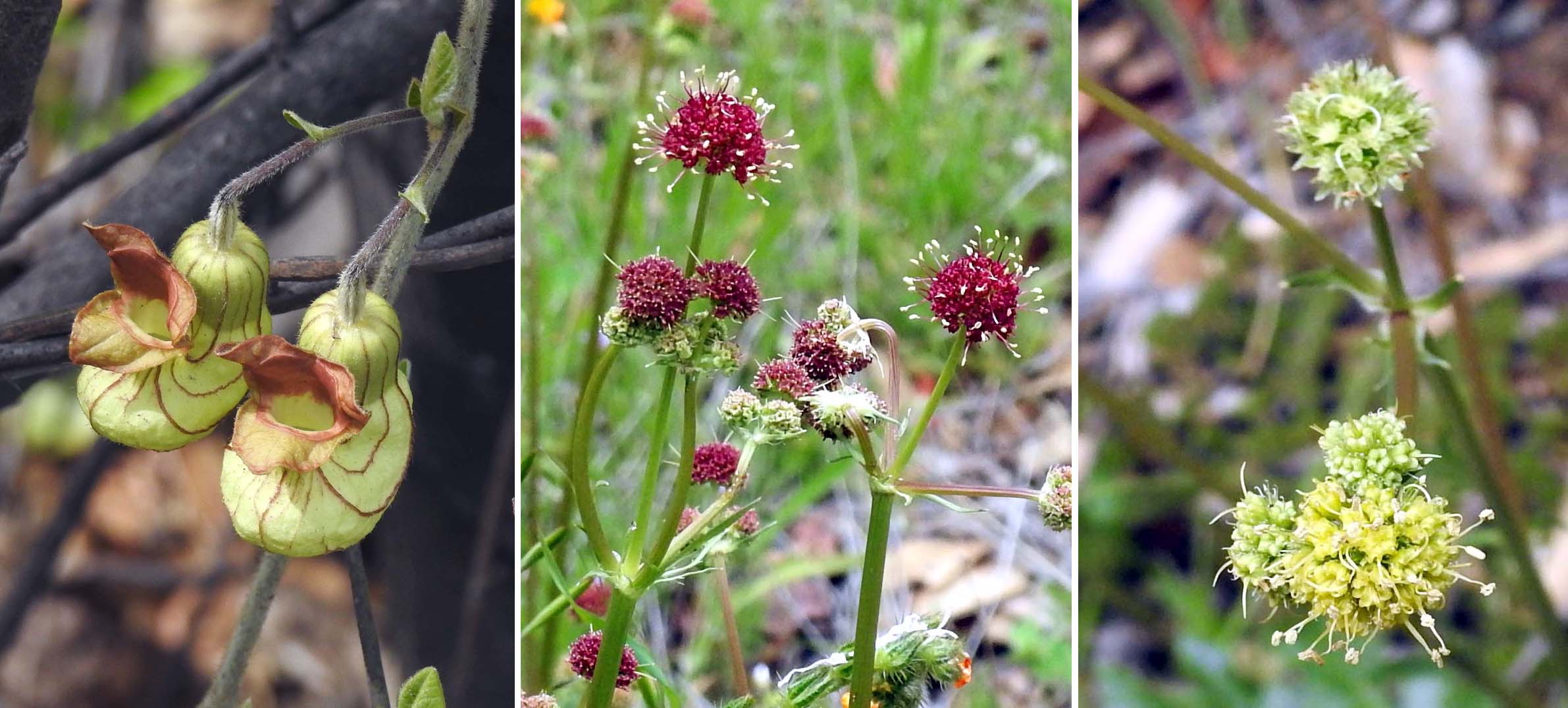
Dutchman's Pipes - Purple Sanicle - Poison Sanicle
Aristolochia californica - Sanicula bipinnaifida - Sanicula bipinnata

I couldn't agree more with Hank Meals' wish to travel back in time to witness this beautifulWeda ceremony!  It must have been amazingly beautiful!

The above wildflowers were photographed at the South Yuba River State Park 
just this past week!  Get out there if you can and immerse yourself in 
the beauty of thousands of spring wildflowers!

Northern Flicker (male) - Steller's Jay
 Colaptes auratus - Cyanocitta stelleri

More Snow & Rain!

This past week has been snowy and rainy!  On Monday morning we woke up to 3" of wet snow on the ground.  On Thursday and Friday it rained a total of  aproximately 1.5"!  The total precipitation for the week was a little over 2", bringing us to a water-year total of approximately 31"!  I hope March continues to bring lots more wet weather!

 At this time of year the snow melts quickly.  Monday morning I went walking in a blizzard, and every tree was blanketed in snow!  By the afternoon, the trees were totally snow free, and there was an inch or two of patchy snow left on the ground!  I'm grateful for the warmer, longer days and I think the birds are as well!

Northern Flicker (female) - Colaptes auratus 

I haven't discussed our amazing year-round avian residents for a while.  Often overlooked because they are commonly seen, these birds should be applauded for their resourcefulness and hardiness through winter!  

There have been a few Northern Flickers in our neighborhood all winter this year. This is probably due to the general lack of snow on the ground. Unlike other woodpeckers, flickers usually forage on the ground for ants, beetles, moths, snails, flies, larvae, seed and berries! When there is a lot of snow, they migrate to lower snow-free elevations. Measuring 12.5" in length, they are the second largest woodpecker in North America (the Pileated Woodpecker being the largest). They are sexually dimorphic in appearance. The most obvious difference is the bright red "malar" on the male's head, which is absent in the female. More Northern Flickers should be arriving for the breeding season soon!

Steller's Jay - Cyanocitta stelleri

There are about 16 Steller's Jays that live here year-round. Every morning they really squawk to each other. Sometimes they sound quite alarmed! They are very inquisitive, and are usually the first to notice anything new in the area. They eat just about anything including seeds, insects, fruit, garbage, carrion, pet food, and small mammals! Lately I've been watching them fly by with Live Oak acorns in their beaks! Yesterday, I heard what I thought was a woodpecker hammering on a tree trunk. It turned out to be a Steller's Jay pecking on an acorn, that he was holding against the top of a branch!

Common Ravens - Corvus corax

We have two Ravens that live in our canyon year-round. I watch them fly by daily as they head down to the highway, from their distant up-canyon roosting area. The highway is a good source of food for these ravens, as roadkill provides carrion. Ravens have a diverse diet that includes arthropods (even scorpions), amphibians, reptiles, birds (adults, chicks, and eggs), fish, small mammals, carrion, grains, buds, and berries. Invertebrates consumed include Orthoptera, Lepidoptera, Coleoptera, craneflies, ants, slugs, scorpions, earthworms, snails and diversity of marine invertebrates. There isn't any research available that states that Ravens mate for life.  However, family members usually stick together for years. 

Other year-round residents are the Spotted Towhee, Black Phoebe, Song Sparrow, Great Blue Heron, Belted Kingfisher, American Dipper, Canada Goose, Sharp-shinned Hawk, Cooper's Hawk, Northern Goshawk, and sometimes the Common Merganser!

                                                Spring Rain - ©Kok 2015

More Damp Earth Art!

 Since we still need more rain, I am continuing to maintain this blog and am again sending out yet another "Call for Art" in celebration of rain. My intention is to focus on the need for rain, and through collective positive energy invoke rain to fall. It is just a wish, a thought, and a hope. If you would like to submit some art, or writing, or a photo please email me at northyubanaturalist@gmail.com. Check out what's already been submitted at dampearthart.blogspot.com

You can view what was submitted last year at dampearth.blogspot.com.
I will be posting new art weekly. Check it out and pray for rain.


Are anymore plants blooming?

What's happening in the Lakes Basin?

What kind of insects are out and about?


Check back next week for the answers to these questions and more!

Unfortunately you can no longer sign up to get my blog emailed to you.
Something changed at Blogspot.com. Oh well... However, my blog looks better if you just go to northyubanaturalist.blogspot.com, rather than get the emailed version. I suggest that you just bookmark my blog and visit it every Sunday afternoon!

Your questions and comments are greatly appreciated! Please feel free to email me at northyubanaturalist@gmail.com. Thanks!

Friday, March 12, 2021

The Open Slope Again!

Columbian Black-tailed Deer - Odocoileus hemionus columbianus

At least 4 mornings a week I check out what's happening at the Open Slope.  This week the Columbian Black-tailed doe, was out foraging with her two offspring!  The juveniles bounded off before I got their photo, but the doe stayed and browsed on plants.  Female offspring stay with their mother for two years after birth.  Male offspring stay for one year.  The two juveniles were probably born last June or July, so they'll be with their mom for a while still.  Right now I can't tell if they're male or female.

Mule deer don't have upper incisors or canine teeth and can't nip off twigs.  They must press plants between their upper hard palate and their bottom teeth and jerk their heads up to tear them off.  In winter they mainly eat the growing tips of trees and shrubs, as well as acorns, fruits and berries.  They are ruminants and have 4 stomachs in which food is fermented before it is digested.  Their stomachs are small, so they select the most nutritious parts of plants that are high in fiber but low in starch.  Some of their preferred forage is Ceanothus, Douglas Fir, Stonecrop, Manzanita, Creek Dogwood, Black Oak, and Elderberry.

American Kestrel (male) - Falco sparverius

About two weeks ago I spotted the American Kestrel in a cloud of non-biting midges.  Neither species eats the other, but they both like the tops of trees!  I haven't seen the Kestrel or the midges since.  The Kestrel has probably moved on to greener pastures where food is more readily available.  The midges have possibly finished with their mating flights for the year!  Such a beautiful sight!

Common Goldeneye (male) - Bucephala clangula

The section of the river below the open slope is a favorite feeding area for Common Goldeneyes.  All winter long I have seen them there, diving under water in their search for fish, crustaceans, and aquatic insects.  They will be leaving for their breeding grounds across Canada and Alaska, in the near future.  Now that the sun in shining on the river in the morning the males look especially gorgeous against the sunlit green river!

River Otter - Lontra canadensis

 It is a ways down to the river from the top of the slope.  You can also see quite a ways upriver from there.  I had been watching the Common Goldeneyes on the river with my camera, when I noticed  a much bigger wake in the river.  Something large was swimming to shore.  Unfortunately the bushes hid the shoreline, so I couldn't see what it was but I suspected it might be a River Otter!!!  I got two quick blurred photos of the mystery swimmer (see orange arrows above) when it was quite distant.  I enlarged them on my camera and thought for sure that it was an Otter!  Since it was headed upriver, I thought I'd take my chances and run to an upriver spot where I'd seen River Otters once before.  If I went fast enough I thought I just might get there in time. 

River Otter - Lontra canadensis

So I hot-footed it upriver about a mile, and bigger than heck the River Otter was sitting on a rock ledge across the river!  WOW!!!  It was rolling around under some leafless bushes on the ledge.  When it saw me it instantly dropped down off the ledge into the river and disappeared!  This was right on a bend in the river, and there was a willow island in the bend that blocked the view of the river.  So I walked upriver past the willow island to see if it would appear, but it didn't. 

River Otter - Lontra canadensis

I knew I should head home as my husband was waiting for me, but decided to take one more look at the rock ledge just in case the otter had returned.  So I walked back past the willow island, and the otter was there again, grooming itself on a tuber and grass hummock on the same river edge!  WOW!!!

It was quite large!  The biggest one I've ever seen!  I have since read that they can reach approximately 5 feet in length, including the tail, and weigh up to 33 lbs!  It posed for me for about 20 seconds and then dove back in the river.  I decided I should leave and let it have its morning to itself.  

River Otter - Lontra canadensis

I was so surprised that the Otter was on the ledge when I got there, as he had a much longer route to swim, than the route I ran.  Swimming is second nature to River Otters.  They are powerful swimmers!  They can travel 440 yards underwater without surfacing, hold their breath for 8 minutes, dive to a depth 70', and swim 26 river miles in a day!  Their nostrils and ears close underwater.  They mainly hunt at night, using their long whiskers to locate prey, but I have seen them catch fish during the day.  They eat fish, crayfish, turtles, muskrats, ducks, frogs, garter snakes, and newts.  

For four years I've been visiting the Open Slope frequently.  Sometimes I walk there, and other times I stop and park on my way home.  I'm always on the lookout for River Otters, but this is the first time I've ever seen one on this part of the river!  I looked it up when I got home, and I had seen a River Otter further upstream a year and a day before, on March 2nd!  Maybe this was the same otter on his annual journey up the river!  You just never know!  What a huge gift it was to see this beautiful wild animal three times in one morning!  WOW!!!

View of the surrounding hills from Quail Valley

Quail Valley

A week ago, my friend Nancy and I went for another foothill hike, down in Quail Valley.  We had never been there before.  It is part of the Daugherty Hill Wildlife Area, operated by the California Department of Fish and Wildlife, which is approximately 7,000 acres (in four parcels) of rolling hills covered with blue and live oak, gray pine, thick brush, and poison oak. Domestic cows also roam free in the area. There are no trails, just cow footpaths and a bunch of dirt roads that meander through the woodlands. It was a beautiful blue-sky day so we headed north on a footpath to see what we could see!

Western Meadowlark - California Quail - California Towhee
Sturnella neglecta - Calipepla californica - Pipilo crissalis

Right away we saw a Western Meadowlark calling from a high branch!  This photo doesn't show its beautiful yellow throat, breast, and belly.  In the right light they are a gorgeous saturated golden-yellow.  I was surprised how long and sharp their beaks were.  In Sierra Nevada Birds, David Lucas states, "Their sharp bills are adapted for "gaping", the ability to forcibly open their bills to pry open crevices or dig in the soil."  They feed on grubs, insects, and seeds on or in the ground.

We heard, but didn't see, a California Quail while we were there.  We also saw a California Towhee, Golden-crowned Sparrow, and a Mourning Dove.  There weren't lots of birds yet.  Perhaps in a week or two there will be more in the area.

Red Maids - Nemophila sp. - Pygmy Poppy (?) - Hooker's Saxifrage
Calandrinian menziesii - Nemophila sp. - Eschscholzia minutiflora 
Micranthes integrifolia

We saw a few wildflowers, but definitely more will be in view as Spring progresses.  We'll have to revisit soon!

 Valley Oak - Quercus lobata

Although predominantely a Blue Oak forest we also came across some huge Valley Oaks!  This one was a good 15' in circumference!  In Trees and Shrubs of California by John D. Stuart and John O. Sawyer it states, "Valley Oak is considered to be an uncommon species, largely because of loss of habitat to agriculture and urbanization.  Where it does occur, it provides important habitat for wildlife.  Native Americans ground its acorns into meal."

Pacific Chorus/Tree Frogs - Pseudacris regilla

There were several small ponds scattered throughout the area, probably for cows to drink out of!  One of them was teeming with aquatic wildlife!

Frog eggs with embryos - tadpoles - snail

We found tree frogs, snails, spiders, some aquatic insects, and frog eggs with lots of embryos in them!  Next time I'll bring a bowl and see what else is in the algae covered bottom!

Valley Oak Silhouette - Quercus lobata

 As we left the wildlife area, the beginning of storm clouds started to move in. We had big hopes that the predicted storm would bring much rain and snow!

It's snowing!

More Damp Earth Art!

A cold winter storm just rolled through and we got approximately 2.78" of precipitation in the last four days!  We ended up with about 4" of wet snow on the ground!  Up in Sierra City, they got about 1.5' of powdery snow!  I'm sure the Lakes Basin got even more!  Since we still need more rain, I am continuing to maintain this blog and am again sending out yet another "Call for Art" in celebration of rain. My intention is to focus on the need for rain, and through collective positive energy invoke rain to fall. It is just a wish, a thought, and a hope. If you would like to submit some art, or writing, or a photo please email me at northyubanaturalist@gmail.com. Check out what's already been submitted at dampearthart.blogspot.com

You can view what was submitted last year at dampearth.blogspot.com.
I will be posting new art weekly. Check it out and pray for rain.


Happy Saint Patrick's Day!


In celebration of all things Green!


What's happening in the Lakes Basin?

Are anymore plants blooming?

What kind of insects are out and about?


Check back next week for the answers to these questions and more!

Unfortunately you can no longer sign up to get my blog emailed to you.
Something changed at Blogspot.com. Oh well... However, my blog looks better if you just go to northyubanaturalist.blogspot.com, rather than get the emailed version. I suggest that you just bookmark my blog and visit it every Sunday afternoon!

Your questions and comments are greatly appreciated! Please feel free to email me at northyubanaturalist@gmail.com. Thanks!

Saturday, March 6, 2021

Signs of Spring

Male Willow Catkins - Salix sp.

The weather these past 10 days has been sunny with daytime temperatures in the 50's and 60's. This sudden warmth has triggered the blooming of plants as well as the activity of insects, birds, and amphibians!  Spring is on the way!  

After many months of having colorful but bare branches, the local willows have burst into bloom!  Willows are dioecious, and have separate male and female plants!  Right now both male and female plants are just past their "Pussy Willow" stage.  Their soft silvery hairs kept the developing reproductive parts of the plant warm!  Unlike most "non-attractive" (not bright in color) flowers, willows are insect pollinated.  The female flowers produce a large amount of strongly scented nectar, and the male flowers produce a ton of pollen! Each male pussy willow has approximately 270 flowers with two stamens each!

Male Alder Catkins & tiny Female Cones
Mountain Alder - Alnus incana ssp. tenuifolia

Alders are monoecious, and have both male and female parts on the same tree.  The long dangling catkins, are the male flowers.  The tiny cones above the catkins are the female "flowers".  Unlike the willows, alders are wind pollinated, and do not depend upon insects for their pollination!  Alders live in a symbiotic relationship with the bacteria Frankia alni.  This bacterium lives underground, in the root nodules of the alder.  The bacterium absorbs nitrogen from the air and makes it available to the alder!  In turn, the alder provides sugars to the bacterium, which it produces through photosynthesis!  

White-leaf Manzanita - Arctostaphylos viscida

There's a picnic area on the North Yuba River, called Convict Flat, that's down near Indian Valley. I like to go there at this time of year to see the blooming White-leaf Manzanitas! These Manzanitas are 4'-12' tall and bloom in late winter! Last year there were bumblebees and robber flies on the blossoms. This week I saw a few bumblebees and a female hummingbird feeding on the blossoms!!! 

Manzanita blossoms hold on tightly to their pollen. This is to keep the pollen from washing away in the winter rains. When a bee buzzes a "middle C" buzz inside a flower, the pollen explodes off the anthers and sticks to the bee's belly! This is called buzz pollination or "sonification". Wow!!!

Anna's Hummingbird(?) (female) - Calypte anna

This is probably an Anna's Hummingbird, but I'm not sure.  They live year-round in the Sierra. They do not migrate to the tropics like most hummers. In the winter, they move down to the foothills, where they can find tiny insects and spiders to eat. They come back up to our area when winter blooming plants are in flower! In the foothills they begin nesting in December! They will start nesting in our area, when enough food is available.

Sandhill Cranes - Antigone canadensis

Every year at this time the Sandhill Cranes fly over our neighborhood!  I just love hearing their loud calls, while watching them head north to their breeding grounds in northern California, Oregon, Washington, Idaho, Canada and Alaska!  This western population of Sandhill Cranes spends the winter in the Sacramento and San Joaquin Valleys of California, where they number in the tens of thousands!

Sandhill Cranes are one of North America's largest birds. They are approximately 4 feet tall, weigh 10 lbs., and have a wingspan of up to 7 feet! They are mainly herbivores, but will also consume small mammals, insects, snails, reptiles and amphibians. They do not hunt in marshes or lagoons, but can be found on dry land near wetlands. They will however lay their eggs, and nest on small "islands" in bogs and marshes. Their young are born precocial (covered in down and with their eyes open) and can leave the nest within one day! However, they usually stay together as a family group for 9-10 months.

Frog eggs coated with algae 

I've been looking for frog eggs in the roadside ditch that I walk past almost every day, and finally found some two weeks ago.  Now that it's warmed up, their development is progressing rapidly!  
 
Frog egg development over the past two weeks 
Possible Pacific Chorus Frog (treefrog) eggs - Pseudacris regilla

 In Pacific Tree Frogs breeding takes place from January to May. The female lays an egg mass containing 10-70 eggs. This eggs mass is laid in a temporary pond, where it floats, attached to pond vegetation, about 3-4 weeks before hatching. The colder the water is, the longer it takes for the eggs to hatch. This is the embryonic stage of a frog.  Once they hatch, they will remain tadpoles for approximately 3 months before they are fully formed adults!!

 Combed-mouth Mayfly (male adult) - Orbweaver Web 
Ameletus sp. - unknown orbweaver spider

With the warm weather, tons of insects have become active! I was super surprised to find an adult mayfly on the river rocks! It seemed a bit early for it to be out of the river.  I only saw one of these adults, but maybe more were nearby.  As nymphs, mayflies live underwater for 1 to 2 years, depending on the species.  They scrape and eat algae and other micro-organisms off of underwater rocks.  When their nymphal stages end, the nymphs will crawl out of the water onto rocks or plants, their exoskeletons will dry out and crack open, the adult will pull itself out of the exoskeleton, pump up its wings, dry out, and fly away!  As adults, Mayflies do not eat, and live for less than 24 hours!  Just long enough to mate and lay eggs for the next generation!
----------------------------------
Even though the nights have been cold, spiders are back in action! The spider eggs were laid in the fall, with up to several hundred eggs in one sac! Now, because of the warm daytime temperatures, they have hatched. Female spiders are the ones that weave the webs, usually at night. Males do not spin webs and are not commonly seen. They are smaller than the females, and are constantly on the move looking for a mate!

The female will use the web to trap insects. Once they're stuck, the female will bite the insect, wrap it in silk and wait for it to die. Once it dies, the female vomits digestive fluid over the wrapped dead insect, to soften it, then eats it by chewing and sucking! The female spider doesn't get stuck in her own web because she mainly travels on the non-sticky structural lines. Sometimes she has to walk on the sticky spiral lines, but her hairy legs have an oil that keeps them from sticking!!!

Female spiders can spin up to 7 different kinds of silk, depending upon their needs! All seven kinds of spider silk have high tensile strength and are extremely stretchy! The silk itself is made up of protein fibers. Dragline silk is used for the outer rim and spokes of the orb, and is weight-for-weight stronger than steel!!! Capture-spiral silk is used for the capturing lines of the web. It's sticky and extremely stretchy and tough. Aciniform silk is used to wrap captured prey, and is two to three times tougher than the other silks! Wow!

View of the Sutter Buttes from the trailhead

 Bobelaine Audubon Sanctuary

Last week we drove down to the Bobelaine Audubon Sanctuary south of Yuba City.  We had never been there before so it was an adventure for us!  On the way there we passed lots of orchards filled with flowering wild mustard and oxalis!  Just gorgeous!  

In 1975, Bob and Elaine Crandall gave this sanctuary, 430 acres, to the National Audubon Society.  They wanted it to be preserved and protected as one of the last riparian forests in California's Great Valley.  Currently less than 2% of the original river forests remain in California.  There are over five miles of hiking trails that loop through the sanctuary.  We took the Center Trail that wound through a mature Valley Oak/Sycamore forest, past meadows, and on to a view of the Feather River.  

Lake Crandall - Double-crested Cormorant (inset)
Phalacrocorax auritus

The first thing we saw was Lake Crandall.  There were two great egrets that flew off as we approached, but we managed to watch a Double-crested cormorant for a while. These fish-eating birds are probably year-round residents in the Central Valley.  

Red-eared Sliders and two possible Western Pond Turtles
Trachemys scripta elegans - Actinemys marmorata

Unfortunately Lake Crandall is a home for 100's of Red-eared Slider Turtles.  (I'm not sure if the two smaller turtles in the above photo are Western Pond Turtles or young Red-eared Sliders.)  Although Red-eared Turtles are native to some areas in the southern United States, they are NOT native to California and have become a destructive invasive species in the sluggish waters of local ponds and lakes. They are a worldwide problem, and are considered one of the top 100 invasive species in the world!

Wikipedia states: "Invasive red-eared sliders cause negative impacts in the ecosystems they occupy because they have certain advantages over the native populations, such as a lower age at maturity, higher fecundity rates, and larger body size, which gives them a competitive advantage at basking and nesting sites, as well as when exploiting food resources. They also transmit diseases and displace the other turtle species with which they compete for food and breeding space."

Californiaherps.com states: "The introduction of non-native turtles into Western Pond Turtle habitat, especially the two most successful invasive turtle species, the Red-eared Slider and the Painted Turtle, has been another cause of the decline of the Western Pond Turtle. Both species are common in the pet trade and feral turtles now found in California were most likely released by their owners. Since the Western Pond Turtle is the only native freshwater turtle in its historic range, it did not develop the ability to successfully compete for resources with other species of turtles, and both the Red-eared Slider and the Painted Turtle produce nearly twice as many offspring as the pond turtle which allows them to overwhelm and out-compete the pond turtle population."

Western Sycamore - Valley Oak - Domestic Plum (?) 
Platanus racemosa - Quercus lobata - Prunus sp (?)

All of the trees still had bare branches, which created a beautiful lacy tangle of limbs. It was shaded and hushed in the thicket-filled Western Sycamore/Valley Oak forest.  At one point three Mule Deer silently crossed the trail in front of us and disappeared quickly (too quick for a photo!) into the bushes!  

Domestic Plum - Prunus sp (?)

 Interspersed throughout the sanctuary some kind of fruit tree was in full bloom, perhaps a type of plum. The striking white blossoms contrasted beautifully with the dark bare-limbed trees.

Feather River

After hiking a mile and a half through the forest we came out to a view of the Feather River!  It was sparkly and gorgeous and a great place to have our lunch!  Several Seagulls passed by while we were enjoying the view, and a few Canada Geese were on the shoreline. The sun felt great after the shady forest!

 Hermit Thrush - Northern Mockingbird - Oak Titmouse
  Cathatrus guttatus - Mimus polyglottos - Baeolophus inornatus

After a while we headed back into the river-forest and looked for songbirds.  Several Hermit Thrushes appeared along the trail, as well as Mockingbirds, and an Oak Titmouse!  We also saw Spotted Towhees, Western Bluebirds, and White-crowned Sparrows. It was SUPER windy, so there weren't many raptors around, except for an American Kestrel and several Turkey Vultures.

 
After several hours of hiking we headed home, passing a flower filled orchard on the way.  It was a lovely day, in a brand new area.  We'll definitely come back again!

Oxalis - Red Maids
Oxalis Valdiviensis - Calandrinia menziesii

                                            "Spring Rain" ©KoK 2001

More Damp Earth Art!

Since the local rainfall total at this point is way below our normal amount, around 25", I am once again sending out a "Call for Art" in celebration of rain. My intention is to focus on the need for rain, and through collective positive energy invoke rain to fall. It is just a wish, a thought, and a hope. If you would like to submit some art, or writing, or a photo please email me at northyubanaturalist@gmail.com. Check out what's already been submitted at dampearthart.blogspot.com

You can view what was submitted last year at dampearth.blogspot.com.
I will be posting new art weekly. Check it out and pray for rain.

Sierra Buttes - 3/1/21

What's happening in the Lakes Basin?

What's happening on the river?

What bugs are out and about?

Check back next week for the answers to these questions and more!

Unfortunately you can no longer sign up to get my blog emailed to you.
Something changed at Blogspot.com. Oh well... However, my blog looks better if you just go to northyubanaturalist.blogspot.com, rather than get the emailed version. I suggest that you just bookmark my blog and visit it every Sunday afternoon!

Your questions and comments are greatly appreciated! Please feel free to email me at northyubanaturalist@gmail.com. Thanks!